Government Taxation, Spending, and Debt
An F-35 inventory audit raises a basic spending question: can the Pentagon verify what it owns, where each part is, and whether it can be used before ordering a replacement?
What to Know
- The F-35 program includes approximately 26 million parts valued at $31 billion across more than 700 facilities.
- GAO found the Pentagon’s central parts records outdated, inaccurate, and incomplete.
- Physical-inventory procedures did not adequately confirm that all parts existed or appeared in the records.
- As of March 2026, the program had not resolved the status of parts valued above $85 million that GAO had previously flagged.
- Incomplete records do not establish that those parts were stolen.
A needed F-35 component might already belong to the Defense Department yet still be unavailable to a maintenance crew. It could sit at another facility, await repair, or appear incorrectly in an inventory system. Without reliable records, managers cannot consistently distinguish those situations from a genuine shortage.
That uncertainty matters when public money funds additional parts. GAO’s November audit examined accountability, while its separate June report documented spare-parts shortages and readiness pressures. Together, they show why better records and sufficient supply are related goals, not substitutes for one another.
Ownership Is Only the First Question
Defense Department ownership establishes who has a claim to a part. A useful inventory must also identify its location, confirm its physical existence, and show its condition and availability for a particular aircraft.
GAO found that the F-35 program’s accountable property system did not reflect changes in real time and contained inaccurate or incomplete information. Its physical-inventory procedures also failed to adequately verify existence and completeness. Those weaknesses limit reliable financial reporting and make maintenance planning harder.
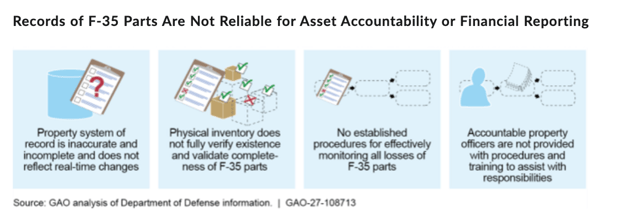
The audit identifies weaknesses in the records and checks needed to account for Pentagon-owned parts, via U.S. Government Accountability Office.
A record discrepancy requires investigation. It does not reveal, by itself, whether a component was misplaced, transferred without a timely update, damaged, consumed in maintenance, or stolen.
Why a Better Count Does Not Eliminate Shortages
Accurate accounting cannot manufacture a part that is unavailable. GAO’s June sustainment review found persistent shortages and industry-capacity constraints even as the F-35 program pursued a strategy to improve readiness. Across the fleet, the share of time aircraft could perform at least one assigned mission fell from 67% in fiscal 2021 to 44% in fiscal 2025. GAO did not attribute that entire decline to inventory-record errors.
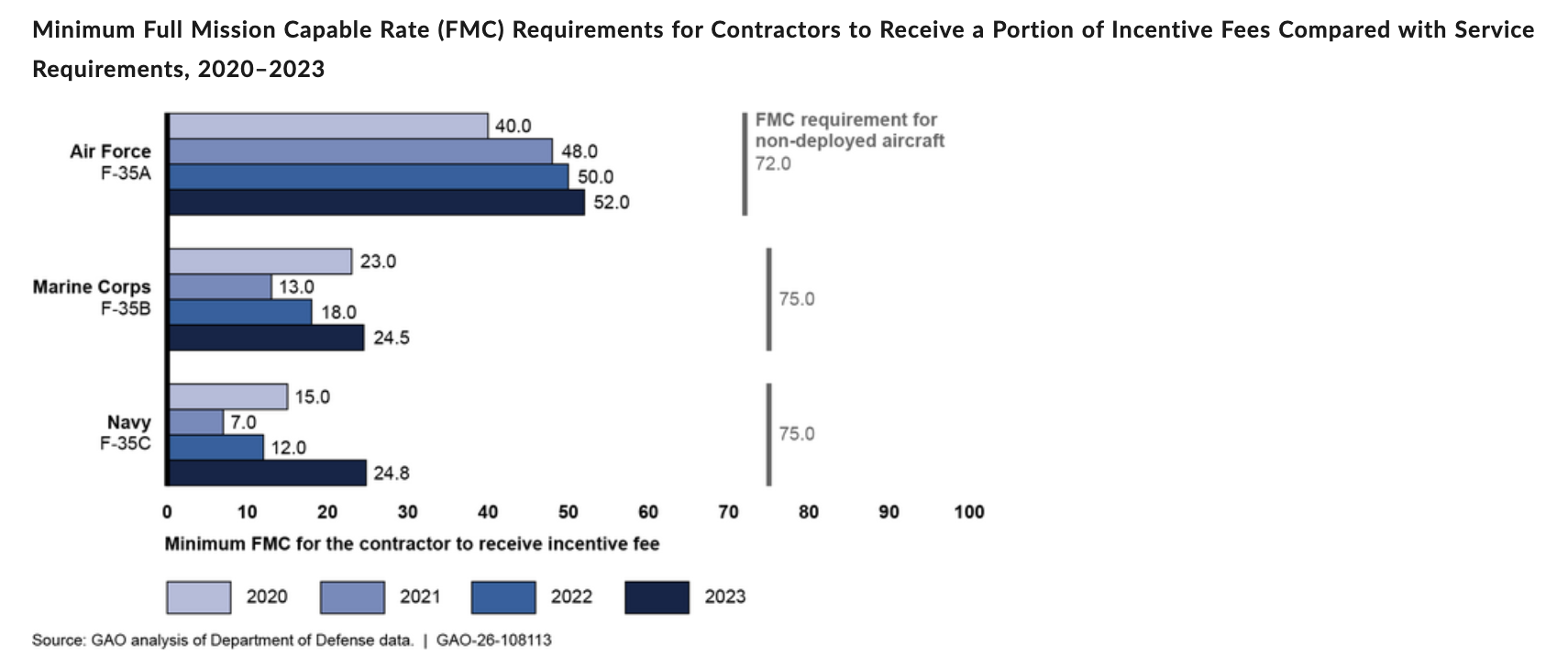
Contractor incentive thresholds did not consistently align with military service requirements, illustrating a separate readiness-oversight problem, via U.S. Government Accountability Office.
That distinction should guide purchase decisions. Some replacements may be urgently necessary; others may be avoidable if an existing part can be located, repaired, and delivered in time.
What Evidence Should Come Before Another Order?
For a proposed purchase, lawmakers could ask the F-35 Joint Program Office to show the verified stock count, the locations and condition of existing parts, the number already committed to repairs, and the expected delivery time for usable inventory. They could also request documented reconciliation of unexplained discrepancies and evidence that the requested quantity reflects actual maintenance demand. These are proposed oversight questions, not a claim that GAO established a new purchasing rule.
GAO recommended stronger loss-monitoring procedures and program-specific instructions and training for personnel responsible for property accountability. Defense officials concurred with its four recommendations; GAO lists them as open.
Wrap Up
Taxpayers need both a capable aircraft fleet and a defensible accounting of the parts purchased to maintain it. Missing or unreliable records cannot prove theft, but they can obscure real shortages and weaken decisions about additional spending.
Before approving replacement quantities, policymakers should ask whether the Pentagon can establish ownership, physical location, usable condition, and timely access. Better evidence can reveal when a new purchase is necessary and when the government should first put a part it already owns to work.