
Legislative Issues
China’s control over rare earth processing puts everyday electronics, batteries, and U.S. defense supply chains at risk.
What to Know
• China controls about 85 to 90% of global rare earth processing.
• Rare earths power phones, batteries, magnets, electronics, and defense systems.
• Traditional mines can take years to permit and operate.
• Secondary recovery means pulling minerals from red mud, tailings, e-waste, and other waste.
• A $250 million facility aims to scale alternatives.
VIDEO CAPTION: Experts examine minerals and supply-chain security.
At the Energy Imperatives Summit Day 2, the minerals discussion turned a distant supply-chain problem into a household issue. The materials inside phones, batteries, electronics, and defense systems are not guaranteed if an adversary controls the processing step that turns mined material into usable parts.
That is the danger for America behind China’s rare earth dominance. America does not only need more mines. It needs faster recovery from materials already above ground, new processing capacity, and trusted partner zones that can move supply chains away from Chinese pressure.
Minerals Are a Household Risk
Rare earths sound obscure because most families never buy them directly. They show up inside the products people use every day, especially magnets, batteries, phones, motors, sensors, and advanced electronics.

Audrey Robertson, Assistant Secretary of Energy
Audrey Robertson connected the minerals issue to ordinary life.
“A cell phone doesn't exist without critical minerals and rare earths.”
That statement matters because rare earth dependence is not only a Pentagon problem. It can also affect families at home. If China can restrict materials used in magnets and electronics, costs and delays can reach vehicles, devices, appliances, and repair parts.
The same supply chain also supports national defense. Rare earth magnets and materials are used across missiles, aircraft, submarines, radar, drones, and weapons. CSIS reports that China accounts for roughly 70% of rare earth mining, 90% of separation and processing, and 93% of magnet manufacturing.
Processing Bottleneck Gives China Power
The United States has resources, universities and labs. What it lacks is a complete path from raw mineral to finished magnet.
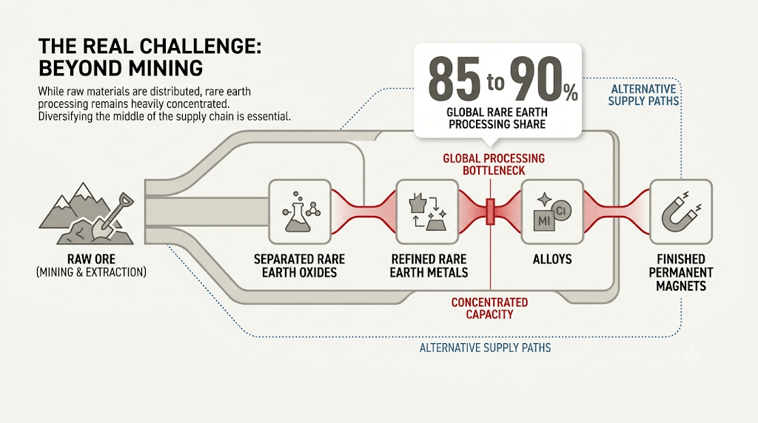
China dominates rare earth processing. Created via Gemini.
The summit framed the bottleneck clearly. China controls something like 85 to 90% of rare earth processing. CSIS similarly says China is responsible for about 90% of processing.
Mining ore is not enough if separation, refining, alloying, and magnet-making still move through China. A supply chain can look domestic at the mine and still depend on Chinese processing.
A phone brand or car company may buy a finished component, not raw ore. If the magnet, alloy, oxide, or metal behind it comes through Chinese-controlled processing, the dependency stays hidden until crisis.
This is why the race is not only about digging. It is about chemistry, metallurgy, permits, financing, and factory scale. China built its advantage over decades by concentrating the middle of the supply chain. America has to rebuild that missing industrial layer quickly.
Secondary Recovery Can Move Faster
Traditional mining remains important, but it is slow. Permitting, financing, building, and operating a mine can take years before producing usable material.
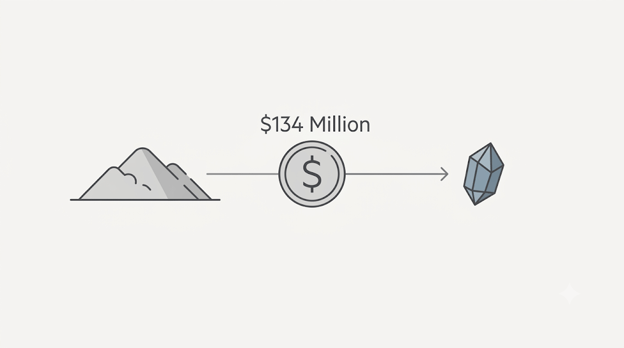
Thirty million tons of red mud could become a domestic mineral source. Created via Gemini.
Audrey Robertson explained why above-ground resources matter.
“What doesn't take as long is to use above ground resources that already exist and then use technology and innovation to separate them.”
That statement shows the strategy. Instead of waiting only for new mines, the United States can recover valuable minerals from red mud, tailings, mine waste, electronic waste, and other materials already above ground.
The Department of Energy announced $134 million for rare earth projects designed to recover and refine materials from waste streams. One Colorado School of Mines project will process red mud, a bauxite refining byproduct, near Gramercy, Louisiana. Colorado School of Mines says the site contains more than 30 million tons of red mud and could supply 150 to 1,000 metric tons per year of rare earth elements for domestic use.
That does not replace mining. It buys time and turns waste into a strategic asset. It also reduces landfill pressure while strengthening industrial resilience before new mines arrive.
National Labs Must Bridge Scale
The hardest part of mineral independence is not discovering a useful idea. It is turning a lab result into a factory process that can produce steady material for manufacturers.
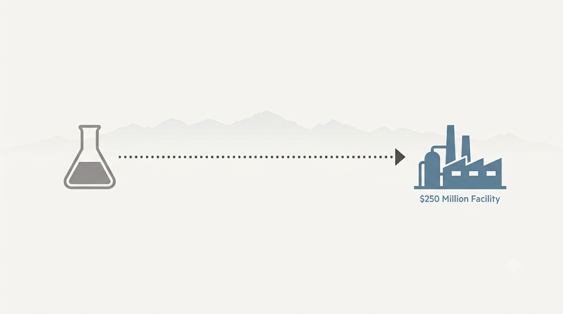
A quarter-billion-dollar bridge from lab bench to factory floor. Created via Gemini.
Robertson said the Department of Energy is bringing science and innovation to critical minerals. She pointed to national lab programs, the Critical Minerals Institute, and a Critical Minerals Center of Excellence in Albany, Oregon.
She also highlighted the National Lab of the Rockies and a facility called Energy Materials and Processing at Scale.
Audrey Robertson described the scale-up mission.
“It is a quarter of a billion dollar user facility to help advance technologies from lab and bench scale to pilot and commercial scale.”
That $250 million facility matters because mineral projects often die between a promising experiment and real production. NLR says the facility is designed to move early ideas into prototypes, pilot lines, and competitive manufacturing processes.
Trusted Partner Zones Reduce China Risk
Secondary recovery can help at home, but America cannot solve every supply-chain problem alone. Some low-margin manufacturing and processing steps may need trusted allied locations.
On the summit’s global leadership panel, Jacob Helberg, Under Secretary of State for Economic Growth, Energy, and the Environment, described Paxilica as a grouping for the AI economy and its supply chains.

Jacob Helberg, Under Secretary of State
Jacob Helberg explained why allied economic zones matter.
“The economic security zones are designed to create enclaves in partnered countries that we trust.”
That statement captures the logic. These zones are meant to reduce political and regulatory risk, give investors confidence, and help trusted partners build capacity outside China’s orbit.
Helberg said the goal is to reduce single points of failure and give factories access to vital inputs. For minerals, that means allied processing, refining, manufacturing, and shipping routes that cannot be switched off overnight by Beijing.
Chokehold Must Break Before Crisis
China’s rare earth leverage is not theoretical. Recent export controls show how quickly Beijing can turn minerals into a pressure tool. CSIS says China’s newer restrictions create major defense supply-chain implications and give Chinese authorities discretion to delay or deny exports tied to sensitive uses.

A supply squeeze can reach household budgets fast. Created via Gemini.
For families, the danger is still real in daily life. If mineral supply tightens, electronics, batteries, vehicles, appliances, and medical equipment can become more expensive, delayed, or harder to repair.
The goal is not total self-sufficiency. It is having backup choices. A secure country can buy from allies, recover from waste, process at home, and keep enough capacity outside China to prevent coercion. That buffer protects households, manufacturers, and troops when politics turn hostile.
For national security, the risk is more direct. A military that depends on adversary-controlled inputs is vulnerable before a war begins. A factory that cannot get magnets cannot produce at speed.
Wrap Up
Breaking China’s chokehold means moving faster than traditional mining timelines allow. America needs mines, but it also needs secondary recovery, red mud processing, national lab scale-up, trusted partner zones, and private capital that can survive Chinese price manipulation.
Why this matters at home is simple. Phones, batteries, vehicles, electronics, and defense systems should not depend on a processing chain controlled by an adversary. The race to secure minerals is not only about geology. It is about whether America can still turn science, waste, allies, and industrial policy into real production before the next supply shock arrives.