Social Security
The government's new financial checkup shows the retirement fund is running out of reserves a year faster than expected, and every single recipient takes an automatic pay cut the moment it does.
What to Know
- Social Security's retirement trust fund is now projected to run dry in 2032, one year earlier than last year's estimate
- Every recipient faces an automatic 22% benefit cut the moment reserves are depleted unless Congress acts
- A retired couple receiving average benefits would lose roughly $10,600 per year
- The 75-year funding shortfall has grown from $26.1 trillion to $30.3 trillion in a single year
- Congress has not made major reforms to Social Security's financial structure since 1983
Social Security's trustees released their 2026 annual report on June 9, and the headline is unambiguous. Bipartisan Policy Center summarizes it plainly: the retirement fund's reserves will be depleted in 2032, one year earlier than last year's projection, and unless Congress acts before that date, every recipient sees their check cut by 22% automatically. Peterson Foundation notes that senators elected this year will be serving in office when Social Security becomes unable to pay full benefits.
For more than 71 million Americans currently receiving Social Security payments, this is a household budget problem with a hard deadline. Workers in their 40s and 50s are making retirement savings decisions based on a benefit level that may not materialize without congressional action before 2032.
Why Reserves Are Running Out Faster
Demographics are shrinking Social Security's revenue base faster than prior projections. Workers paying into the system for every beneficiary dropped from more than 5-to-1 in 1960 to 2.9-to-1 today and will fall to 2.2-to-1 by the 2070s. Compounding the squeeze, the payroll tax now reaches only 83% of covered wages, down from 90% in 1983, because higher-income earners' wages have grown faster than the taxable maximum of $184,500.
Congress passed two laws in 2025 that moved the deadline one year closer. One Big Beautiful Bill Act reduced income taxes on Social Security benefits for some recipients, directly cutting revenue flowing into the trust fund. Social Security Fairness Act increased outlays by repealing provisions that had previously reduced benefits for certain government workers.
The Long-Term Gap Is Growing
Trustees also revised the projected U.S. fertility rate downward from 1.9 to 1.75 children per woman, aligned with Congressional Budget Office and Census Bureau estimates. Fewer future workers means less future payroll tax revenue, expanding the 75-year funding gap from $26.1 trillion last year to $30.3 trillion today, per Bipartisan Policy Center.
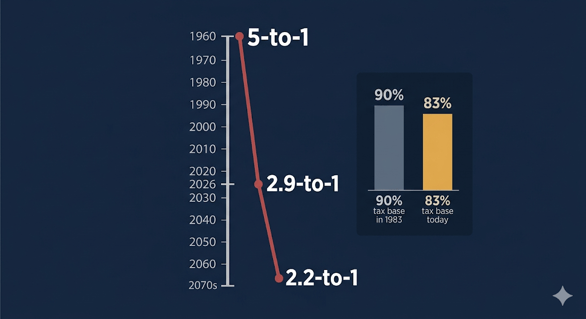
Worker-to-retiree ratio has fallen sharply since 1960. Created via Gemini.

Nancy LeaMond, Executive Vice President and Chief Advocacy Officer, AARP
LeaMond, speaking on the urgency of congressional action, warned:
"Congress needs to act sooner rather than later."
Immigration projections were also revised sharply downward, further reducing the projected pool of future workers contributing payroll taxes and worsening the program's long-run balance across every projection window in the report.
What a 22% Cut Means for Households
Automatic reductions do not fall equally. A retired couple receiving average benefits would lose approximately $10,600 per year, while an average non-disabled widow or widower receiving around $1,800 per month would lose approximately $4,800 per year, per Bipartisan Policy Center. Social Security cannot legally spend beyond its revenues and reserves, so when reserves hit zero, payments cover only 78% of scheduled benefits with no mechanism to protect lower-income recipients from the full reduction.
Wrap Up
Every year Congress delays, the eventual fix grows larger and more disruptive. Acting now allows smaller adjustments phased in gradually, keeping most recipients better off than the automatic cut scenario. Waiting until 2031 forces abrupt changes to taxes, benefits, or both into a narrow window.
For ordinary American households, 2032 is a personal finance deadline. Retirees already receiving checks depend on a program that cuts payments automatically without congressional action. Understanding what a 22% cut means on a monthly budget, and how close that deadline is, separates informed retirement planning from a surprise that arrives with no warning.