Affordability and Costs
A birth rate drop after the 2008 recession is now closing colleges and forcing survivors to compete harder for every student, which puts real money back in your family's hands.
What to Know
- U.S. 18-year-old population is projected to fall 13% between 2026 and 2041
- Vermont's Sterling College closed after spring 2026, the seventh private Vermont college to close since 2016
- Queens University's expenses exceeded revenue by more than $20 million in 2023 before merging with Elon University
- High school graduates enrolling in college dropped from 70% to 62% since 2016
- Merit aid at competing schools has roughly doubled in recent years, giving families real room to negotiate
Colleges across the country knew this moment was coming. Birth rates fell sharply after the 2008 recession and never recovered, producing a smaller pool of 18-year-olds arriving at college gates starting in 2026. CollegeHound's enrollment cliff analysis documents what that demographic math now means for families planning for higher education: fewer students means colleges must compete harder for each one, and that competition is already translating into money.
For ordinary American households, the enrollment cliff is not just a story about campus closures. It is a shift in negotiating leverage that families have never had before, and understanding how to use it could save thousands of dollars in tuition costs over four years.
What Drove the Cliff
Every student entering college in 2026 was born around 2007 and 2008, when the financial crisis caused birth rates to drop sharply. Education Next projects the 18-year-old population will fall 13% between 2026 and 2041, a sustained contraction that gives institutions no demographic relief for more than a decade.
Attitudes have shifted alongside the numbers. A Pew Research survey found 49% of adults believe a four-year degree is less important than it was 20 years ago, and high school graduates enrolling in college dropped from 70% to 62% since 2016. Undergraduate enrollment fell by over 1 million students between fall 2019 and fall 2022 before beginning a modest recovery, and approximately 83 colleges have closed, merged, or announced mergers since 2020.
Closures and Mergers Already Underway
Sterling College in Vermont closed after its spring 2026 semester, the seventh private Vermont college to close since 2016, according to Vermont Public reporting. An estimated 442 private colleges nationally are now considered at risk of closing.
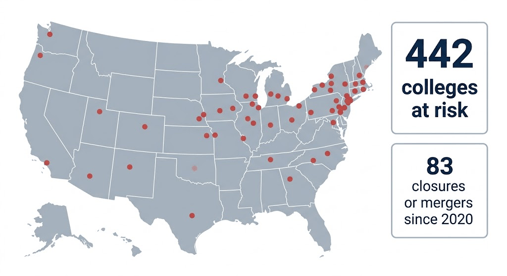
Over 80 colleges closed or merged since 2020. Created via Gemini.
Mergers are becoming a survival strategy for schools with a viable path forward. Alamance News reports that Queens University of Charlotte's expenses reached $109 million against revenue of $88.4 million in 2023, a gap exceeding $20 million, with enrollment down 37% between 2011 and 2024. Elon University absorbed Queens in a full operational merger even as its own 2025 freshman class fell 11.6% year over year.
What Families Can Do Right Now
Declining enrollment has shifted the balance of power between colleges and the students they need to recruit. Families who understand that shift can use it to negotiate better financial aid packages, access larger merit awards, and reduce what they actually pay.

Connie Book, President, Elon University
Book, speaking on the competitive pressure reshaping higher education, noted
"Colleges can no longer simply open their doors and expect students to fill seats. The market has shifted, and institutions that don't adapt will not survive."
Families entering this market hold more leverage than any generation before them. CollegeHound advises that merit aid has roughly doubled at many schools, meaning an offer that was $10,000 five years ago may now open at $20,000 or higher. Asking for a revised financial aid offer is now standard practice because institutions need to fill seats more than at any prior point in modern higher education.
Wrap Up
Regional economies that depend on college campuses face real disruption when institutions close or consolidate. Branch campus closures reduce local employment, shrink student spending in surrounding communities, and remove a pipeline of skilled workers that local employers rely on. Policymakers at the state level have strong financial incentives to act before closure becomes the only available outcome.
For families currently planning for college, the enrollment cliff is an opportunity hiding inside a structural crisis. Apply to more schools, compare merit aid packages across comparable institutions, and make the call asking for a better offer. Colleges that need students will often say yes.