
AI and Automation
AI leaders are calling for universal cash payments to cushion job displacement, but the fiscal math and labor market evidence reveal costs that rarely make it into the pitch.
What to Know
- Elon Musk, Sam Altman, and Marc Benioff have each publicly advocated for UBI as an AI-era safety net
- A national UBI would add trillions in annual federal spending to a deficit already projected at $1.9 trillion in 2026
- Manufacturing jobs fell 34% since 1979 yet manufacturing output rose 98%, and service employment absorbed the displaced workers
- Farm employment dropped from 40% of the U.S. workforce in 1900 to 3.4% by 1980 without a permanent federal cash program
- Software engineering job listings have roughly doubled since mid-2023, with more than 67,000 openings posted as of April 2026
When AI leaders propose Universal Basic Income as the solution to automation-driven job displacement, the argument sounds straightforward. Machines take jobs, government sends checks. Hoover Institution economist John Cochrane identifies what that framing omits: the unseen costs in labor market behavior, federal fiscal capacity, and long-run economic productivity that a permanent UBI would impose on the very households it claims to protect.
Sam Altman walked back predictions of a jobs apocalypse in May 2026, telling Reuters that AI is unlikely to produce mass unemployment. American households should understand what funding a program of that scale would cost before the debate moves from conference panels to congressional budget tables.
What History Says About Automation and Jobs
Every major wave of automation produced the same prediction and the same result. Farm employment fell from 40% of the U.S. workforce in 1900 to 3.4% by 1980 and workers did not become permanently unemployed, according to Hoover Institution research. Manufacturing employment peaked at 19.4 million in 1979, fell 34% to 12.8 million, yet output rose 98% over that period. Displaced workers moved into expanding service and knowledge sectors each time.
Software engineering job listings have roughly doubled since mid-2023 and exceed 67,000 open positions as of April 2026. Overall unemployment sat at 4.3%. Building a permanent entitlement on a displacement forecast that has not materialized locks in fiscal costs before the premise is confirmed.
The Fiscal Problem UBI Advocates Skip
Federal spending reached $7.0 trillion in fiscal year 2025 and the CBO projects the deficit will grow from $1.9 trillion in 2026 to $3.1 trillion by 2036 without any new programs. Adding a universal cash transfer on top of that baseline requires tax increases large enough to fund the program and offset the labor supply reductions that unconditional transfers produce.
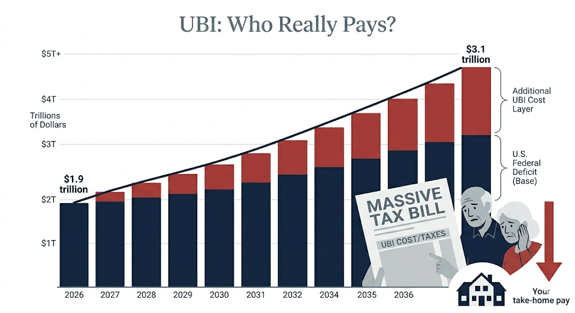
Federal deficit balloons long before UBI enters budget. Created via Gemini.
Hoover Institution frames this as Bastiat's broken window fallacy applied to social policy. Advocates count the visible cash in recipients' hands but not the investment, hiring, and wage growth that never occurs because the tax burden required to fund those transfers crowds it out.
What UBI Does to Labor Markets
Unconditional cash transfers change the calculation workers make about employment. NBER research on UBI pilots found moderate labor supply reductions among recipients. Service-sector jobs depend on a willing labor pool, and a UBI that raises the effective reservation wage tightens that pool, raising service costs for the households the program was intended to help.

John Cochrane, Senior Fellow, Hoover Institution
Cochrane, writing on premature UBI adoption, warned
"The seen effect is cash in people's pockets. The unseen effect is everything that doesn't happen as a result."
For households not receiving UBI, those unseen effects arrive as higher prices, reduced hiring, and a tax bill that shrinks take-home pay while funding transfers to others.
Wrap Up
UBI is a legitimate policy idea worth rigorous debate. What it is not is a costless response to a displacement crisis that has not arrived at the predicted scale. A permanent entitlement built on a forecast requires honest accounting of rising taxes and labor market effects.
For ordinary American households, the question is not whether the checks sound appealing. Understanding whether the net effect on your household budget, after the required tax increases, is positive or negative separates informed policy preference from a reaction to a headline.