Government Taxation, Spending, and Debt
Pass-Through Income: America’s Overlooked Tax Divide
Pass-through businesses support entrepreneurship and investment, but differences in how business...
How rising debt, record interest costs, and Washington's failure to pass long-term reforms are reshaping the American economy.
For most of American history, the cost of borrowing was manageable enough that the national debt stayed in the background of everyday life. That era is over. Federal debt held by the public now stands at 100% of GDP, interest payments have crossed $1 trillion a year, and the government is borrowing nearly $5 billion per day. The consequences are no longer limited to Washington budget fights. They are showing up in mortgage rates, credit card bills, and the shrinking ability of Congress to fund current priorities. What follows breaks down how the debt reached this point, what it costs American households right now, how bond markets are repricing the risk, and what solutions, if any, are being seriously discussed in Washington.
The federal government has carried debt for much of American history, but for most of modern history the cost of servicing that debt remained a manageable line item in the budget. That changed in 2026. For the first time in modern history, annual interest payments on the national debt have surpassed the entire U.S. defense budget, a milestone that signals a fundamental shift in how Washington spends taxpayer money.
The Congressional Budget Office projects federal interest payments will exceed $1 trillion in 2026, while the defense budget sits between $895 billion and $961 billion. The crossover happened because decades of low-rate borrowing ended when the Federal Reserve raised rates sharply starting in 2022. The government is now refinancing a $38.8 trillion debt load at rates it has not faced in a generation. By 2036, net interest costs are projected to reach $2 trillion annually.
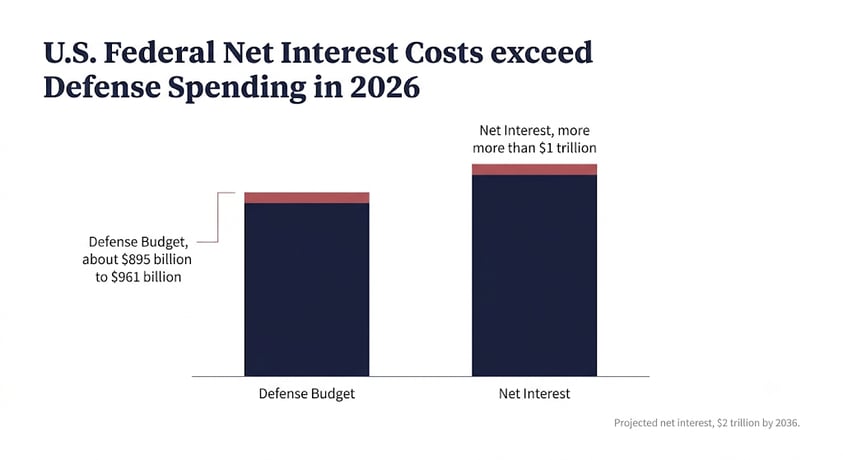
Federal interest costs are projected to exceed $1 trillion in 2026, rising above the defense budget.
What these numbers reveal is a crowding-out effect. Every dollar sent to bondholders is a dollar that cannot fund roads, medical research, veterans' benefits, or education. Unlike defense or healthcare spending, interest payments simply cover the cost of past borrowing. As this share of the budget grows, Congress has less room to respond to future crises or invest in long-term priorities.
The scale of the interest burden has forced some lawmakers to consider structural reform. A bipartisan proposal would move the debt debate into a fast-track process, bypassing the gridlock that has blocked action for years.
If interest on the debt is the problem, the next question is obvious. Why hasn't Congress done anything about it? The answer is that the normal legislative process, committees, amendments, floor debates, partisan negotiations, has repeatedly failed to produce long-term fiscal reform. A bipartisan group of senators is now proposing a structural workaround that would move the hardest decisions into a compressed fast-track process and force Congress into a simple up-or-down vote.
The Fiscal Commission Act, known as S. 4012, would create a 16-member panel made up of 12 lawmakers and 4 outside experts selected by congressional leadership. Their task would be to stabilize national debt at 100% of the economy by 2039 while improving long-term trust fund solvency over 75 years. The real power of the proposal is not the commission itself. It is the fast-track mechanism attached to it. Recommendations approved by the panel would receive expedited congressional consideration with limited debate, limited amendments, and an up-or-down vote. Federal debt has now reached $38.8 trillion, while deficits are projected near $1.9 trillion this year alone.
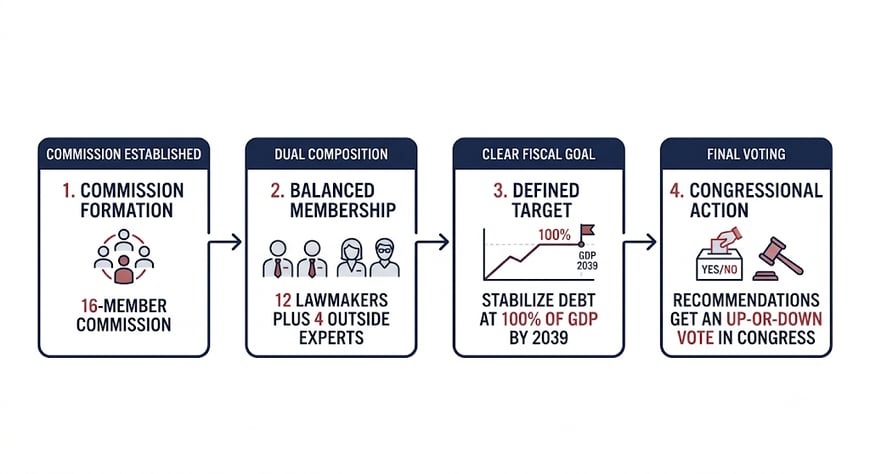
A proposed 16-member fiscal commission would try to force a debt deal through a fast-track vote.
The fast-track structure is designed to solve a specific political problem. Neither party wants to own painful fiscal reforms alone. Spending cuts, entitlement adjustments, and tax increases all carry electoral risk. A bipartisan commission spreads that ownership across both parties while compressing the timeline so that lawmakers have fewer opportunities to delay or block the package. However, critics argue that limiting amendments and floor debate reduces Congress's ability to revise major legislation through the normal democratic process. Voters may find it harder to identify who truly owns the policy choices that come out of a commission rather than open committee negotiations.
Whether or not the commission moves forward, the underlying pressure driving it is not going away. That pressure is already showing up in the bond market, where investors are demanding higher returns to hold U.S. debt, pushing Treasury yields past levels not seen in over a decade.
The conventional expectation was that when the Federal Reserve cut interest rates, long-term borrowing costs would fall with them.That relationship broke down in late 2024. When the Fed cut its benchmark rate by 50 basis points in September 2024, the 10-year Treasury yield did not fall. It rose from 3.65% to a peak of 4.79% by January 2025, reaching its highest term premium since 2011.
The Kansas City Fed's February 2026 research bulletin explains why. Economists Bi, Phillot, and Zubairy found that higher Treasury supply puts upward pressure on both the term premium and the long-run neutral rate.A supply shock that increases the debt-to-GDP ratio by just 1% raises the five-to-ten-year-ahead real term premium by 1.0 basis point, the long-run real short rate by 0.6 basis points, and inflation expectations and the inflation risk premium by 0.3 basis points each.Those increments compound fast when debt is growing by trillions annually. The 30-year Treasury yield recently climbed to 5.19%, its highest level since 2007, and that number matters because long-term Treasury yields are the reference rate from which lenders price virtually every loan in the American economy.
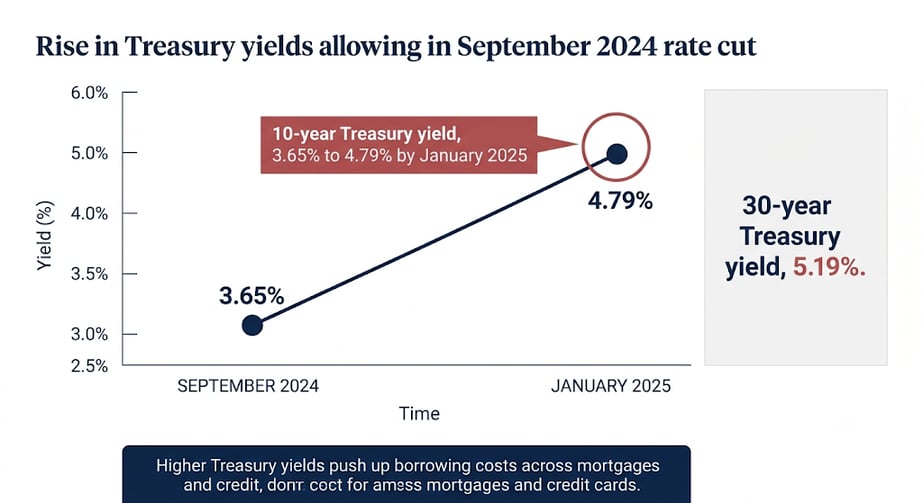
Treasury yields rose even after rate cuts, with the 30-year yield reaching 5.19%.
The result is a borrowing-cost squeeze that reaches households through mortgages, credit cards, auto loans, and small-business credit.Mortgage rates currently sit at 6.72%, credit card debt has reached $1.28 trillion with average APRs at 19.57%, and more than 55% of American adults now use cards to cover basic necessities like groceries, utilities, and rent. According to the Committee for a Responsible Federal Budget, a 55 basis point increase in mortgage rates raises monthly payments on a $500,000 30-year mortgage by nearly $200 and adds $64,000 to its lifetime cost. Every 0.5 percentage point rise in Treasury borrowing costs adds approximately $2 trillion in additional debt expense over the next decade.
The bond market is no longer just a concern for Wall Street traders. It is now the mechanism through which Washington's borrowing decisions reach every household budget in the country. One economist has proposed a framework for understanding how large the problem really is, and what a realistic solution might look like.
The scale of the debt, the political gridlock around fixing it, and how bond markets are already raising borrowing costs across the economy all point to the same question. But is there a single target that could anchor a realistic solution? Investor Ray Dalio argues there is, and it comes down to one number, 3% of GDP.
Washington is running a federal deficit at 6% of GDP, nearly double what Dalio has identified as the threshold between a manageable debt trajectory and what he calls a debt death spiral. The Congressional Budget Office projects deficits will average 6.1% of GDP through 2035, with federal debt rising from 100% of GDP today to 120% by 2036. Dalio warns that unless the deficit is cut to 3%, the supply of Treasury bonds will chronically exceed demand, the Fed will eventually be forced to print money to cover the gap, and currency debasement becomes the mechanically inevitable outcome. The One Big Beautiful Bill Act passed in 2025 adds $3.4 trillion to projected deficits over the next decade, worsening the trajectory further.
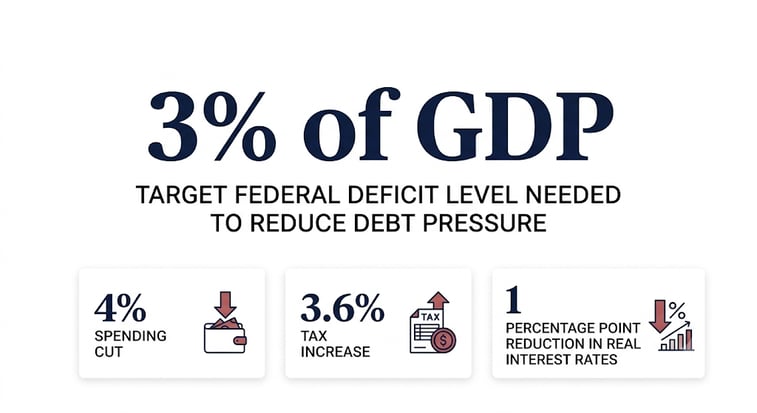
Ray Dalio’s framework aims to bring the deficit down to 3% of GDP through a combined policy adjustment.
Dalio's proposed fix uses three levers working together, a 4% cut in federal spending, a 3.6% increase in tax revenue, and a 1 percentage point cut in real interest rates, phased in over 3 years. No single lever works alone. Cutting spending by 12% or raising taxes by 11% in isolation would each be economically damaging and politically impossible. The interest rate lever is the most powerful. A 1 percentage point drop in real interest rates is 4 times more effective at reducing the debt-to-income ratio over 20 years than a 1% increase in tax revenue. If Congress cannot agree on specifics, Dalio proposes a bipartisan fallback. Automatic equal percentage cuts to all discretionary spending and equal percentage increases to all eligible taxes would continue until the 3% target is reached, so no one bears sole political blame.
The stakes for ordinary households are direct. If interest rates remain elevated above projections, interest costs could consume $17,000 per household annually by 2036, up from $7,900 today. Mortgage rates, credit card APRs, and auto loan rates all reprice alongside Treasury yields. Dalio is not describing a theoretical long-run problem. He is describing a mechanism already running, and a window while the economy remains stable to stop it at manageable cost before the cost becomes unmanageable.
America's debt problem is no longer a future risk. It is a present reality reshaping the federal budget, financial markets, and household finances at the same time. Interest payments have surpassed the entire defense budget at over $1 trillion annually and are projected to reach $2 trillion by 2036. Congress has failed to act through normal channels, prompting a bipartisan push for a 16-member Fiscal Commission with fast-tracked, up-or-down votes. Meanwhile, the bond market is already repricing Treasury risk, with the 30-year Treasury yield at 5.19%, mortgage rates at 6.72%, and credit card APRs at 19.57%, adding nearly $200 per month on a $500,000 30-year mortgage.
Ray Dalio's framework puts the challenge in simple terms. The federal deficit must come down from 6% of GDP to 3% to avoid a debt death spiral.His proposed combination of a 4% spending cut, 3.6% tax revenue increase, and 1 percentage point reduction in real interest rates offers a path, but only if Washington acts while the economy is still stable enough to absorb the adjustment. The window is open, but it is not permanent
-Oct-10-2026-10-01-27-0535-AM.jpg?width=300&name=image%20(1)-Oct-10-2026-10-01-27-0535-AM.jpg)
Pass-through businesses support entrepreneurship and investment, but differences in how business...

All 50 states, Washington, D.C., and Puerto Rico have applied to a new Medicaid drug-pricing model,...

Proposition 40 asks voters to choose a one-time tax on billionaire wealth, raising questions about...