
Financial Literacy, Fiscal Policy
Remote work and high interest rates have pushed office loan delinquencies to an all-time high, creating concentrated stress in the commercial mortgage market that threatens regional bank balance sheets.
What to Know
- Office CMBS delinquency rate hit an all-time high of 12.34% in January 2026
- Overall commercial mortgage delinquency rose to 4.02% in Q1 2026, up from 3.86% in Q4 2025
- $875 billion in commercial mortgages are scheduled to mature in 2026
- Office delinquency has climbed from roughly 1.60% in mid-2022 to over 12% in early 2026
- Over 83% of office CMBS loans that matured before 2026 and are still outstanding are now delinquent
Empty office floors are generating a financial problem that extends far beyond the buildings themselves. Trepp's analysis shows the delinquency rate for office loans in commercial mortgage-backed securities reached 12.34% in January 2026, surpassing the prior peak of 11.76% set in October 2025. Worldwide Plaza at $940 million and One New York Plaza at $835 million each tipped into delinquency and moved the sector rate meaningfully.
For Americans with deposits at regional and community banks, this is not a distant commercial real estate story. Banks holding concentrations of office loans face mounting losses on assets that cannot be sold at original valuations, and understanding how that stress works is the first step toward protecting your deposits.
How Office Loans Got Here
Office delinquencies were negligible before the pandemic. Trepp data shows the rate climbed from 1.60% in mid-2022 to over 12% by January 2026, driven by permanently reduced office demand and rates that made refinancing loans originated at 2018 to 2021 valuations impossible.
Maturity defaults now account for the majority of new delinquencies, as borrowers unable to sell or refinance at viable terms allow loans to expire without payoff. Over 83% of office CMBS loans that matured before 2026 and remain outstanding are now delinquent, and $875 billion in commercial mortgages are scheduled to mature in 2026 alone.
What the Numbers Mean for Banks
Regional and community banks hold significant concentrations of commercial real estate loans, and office exposure sits at the riskiest end of that portfolio. The Mortgage Bankers Association reported overall commercial mortgage delinquency of 4.02% in Q1 2026, with CMBS loans leading all capital sources at 5.21%. Banks holding loans that cannot be marked to current market value without triggering capital ratio concerns face a slow-moving pressure that regulators are actively monitoring.
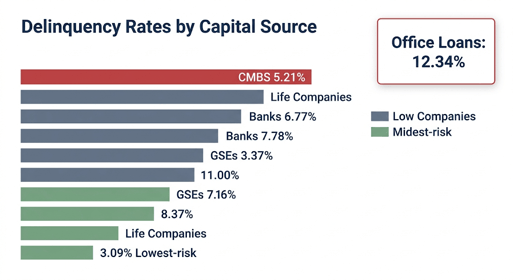
Office loan failures hit banks harder than any sector. Created via Gemini.

Judie Ricks, Associate VP of Commercial Real Estate Research
Ricks, commenting on Q1 2026 delinquency trends across commercial property types, noted
"Delinquency rates vary considerably depending on property type and capital source, with offices continuing to face the most significant challenges."
Some regional banks are projecting renewed CRE lending growth in 2026, a signal that stress is not uniformly distributed. Banks with diversified loan books and lower office concentrations are navigating this environment differently than lenders with heavy urban office exposure.
What Depositors Should Watch
Depositors at regional and community banks have practical tools to monitor their institution before stress becomes a headline. Call reports, filed quarterly by every FDIC-insured bank, show CRE loan concentrations as a percentage of total capital and are searchable through the FDIC's BankFind Suite. A CRE concentration above 300% of total equity is a threshold regulators flag for heightened oversight.
Accounts at FDIC-insured institutions are protected up to $250,000 per depositor per ownership category. Americans holding balances above that threshold should review how their deposits are structured, since coverage can be extended by distributing funds across accounts or institutions.
Wrap Up
Office CMBS delinquency at 12.34% with $875 billion in commercial maturities arriving in 2026 is a structural stress test for lenders concentrated in that asset class. Trepp estimates the rate will peak between 12% and 13% before the distressed loan pipeline clears, meaning the worst data may still be ahead.
Americans do not need to panic about deposits, but attention is warranted. Checking your bank's CRE concentration ratio takes less than ten minutes and is the kind of proactive monitoring that separates prepared households from those caught off guard.