Legislative Issues
California’s AB 1901 shows how statewide coalitions can turn a specialized consumer concern into a serious legislative campaign.
What to Know
- 333 organizations supported California’s AB 1901 through The Children’s Movement.
- The bill would require ingredient disclosure for children’s diapers sold in California.
- Manufacturers would have to identify intentionally added ingredients, their purposes, and relevant chemical information.
- The Senate passed the measure 37–0 on August 26, 2026; the Assembly then concurred 71–1.
- California’s proposal builds on New York’s first-in-the-nation diaper ingredient-disclosure law.
Consumer-protection debates often begin with a problem that receives little attention outside a small group of parents, researchers, or advocates. State legislatures can give those concerns a path into public policy when organizations combine technical evidence with a clear request that lawmakers can understand and act upon.

Consumer Federation of California highlights state-level advocacy efforts.
This work matters especially for infants. A peer-reviewed review of infant skin explains that infant skin is thinner, more permeable, and less developed than adult skin. Because diapers remain against that skin for long periods, parents need clear information about intentionally added ingredients.
A Broad Coalition Behind a Narrow Proposal
Through The Children’s Movement of California, 333 organizations urged state leaders to support AB 1901. The coalition included groups working in child health, education, environmental protection, consumer rights, family services, and community development.
The campaign focused on a narrow and practical request. Rather than seeking a broad prohibition on diaper ingredients, advocates asked lawmakers to require manufacturers to disclose what they intentionally add to their products and why those ingredients are used.
Children Now worked with Assemblymember Marc Berman and bill co-sponsors including Consumer Reports, the Environmental Working Group, and the Center for Environmental Health. The coalition delivered its supporter list to legislative leaders as the bill moved through the Senate.

Children Now graphic showing the 333 supporting organizations.
A large coalition does not settle every policy question, but it can show legislators that an issue reaches beyond one organization or interest group. In this case, parents and caregivers need information that allows them to compare products, while manufacturers need clear and consistent disclosure rules.
The coalition established the case for action; the next question is exactly what information AB 1901 would require companies to provide.
What AB 1901 Would Require
The enrolled version of AB 1901 would require manufacturers of children’s diapers sold, distributed, or manufactured in California to publish a product-specific list of intentionally added ingredients on a dedicated website by January 1, 2028.
For each ingredient, manufacturers would have to provide its chemical or raw-material name, Chemical Abstract Service number, and function within the product. The ingredients would also have to appear in order of chemical or raw-material weight.
The packaging timeline is later. Diaper packaging distributed or manufactured in California would need to display the ingredient list and the manufacturer’s website address by January 1, 2029. Products sold in the state would have to meet the packaging requirement by July 1, 2029.
The bill does not ban specific chemicals. Its policy tool is disclosure. Supporters argue that complete ingredient information would help parents compare products and could encourage manufacturers to reassess ingredients they may be reluctant to identify publicly.
Enforcement would be shared by the California Department of Toxic Substances Control, the Attorney General, city attorneys, county counsel, and district attorneys. Violations could result in administrative penalties of up to $5,000 for a first offense and $10,000 for subsequent offenses.
The California Chamber of Commerce, or CalChamber, filed a formal “Oppose Unless Amended” position. CalChamber raised concerns about proprietary trade secrets and the risk that disclosure requirements could expose confidential business information. Those concerns are part of the implementation challenge: a disclosure law must give families meaningful information while clearly defining how confidential information is handled.
Once lawmakers defined the disclosure requirements and enforcement structure, the bill’s legislative votes showed whether that compromise could attract broad support.
From Coalition Building to Legislative Results
AB 1901 first passed the Assembly by 68–1 on May 26. The Senate then approved the measure 38–0 on August 26. After the Senate amended the bill, the Assembly concurred by 71–1 on August 27. These votes show that the proposal attracted broad support at each final legislative stage.
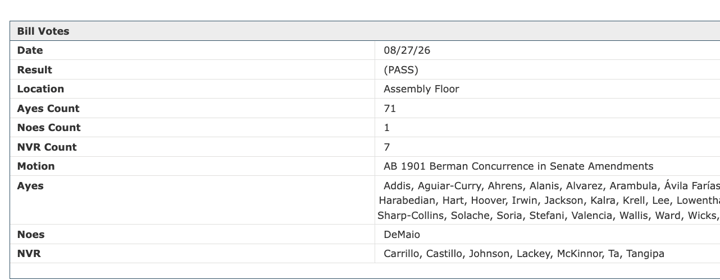
California Legislature vote record showing the final 71–1 Assembly concurrence
These votes do not resolve every question about compliance costs, confidential information, or enforcement. They do show that a focused consumer issue can attract broad legislative support when advocates build a large coalition, present a specific policy response, and remain involved through committees, amendments, and final votes.
California is not acting alone. New York enacted the country’s first diaper ingredient-labeling law in 2024, requiring ingredient lists on diaper packaging sold in the state. New York’s Legislature described the law as requiring clear ingredient information for diapers sold in the state. AB 1901 would build on that precedent by requiring online disclosure of intentionally added ingredients and their functions before California’s packaging requirements take effect.
That state-to-state development matters. Manufacturers may choose to use similar disclosure systems nationally rather than maintain different standards for major markets. It also gives other state legislatures a concrete example of how product-transparency laws can move from advocacy proposal to enacted policy.
The bill’s progress, together with New York’s earlier disclosure law, shows that consumer transparency is becoming a broader state-policy question. That record also offers a practical lesson for advocates seeking to turn a narrowly defined consumer concern into enforceable legislation.
Wrap Up
AB 1901 shows that consumer advocacy is not only about generating public attention. Effective campaigns translate a real household concern into a defined legislative request that lawmakers can evaluate, amend, and enforce.
The legislation would give parents clearer information about diapers used in prolonged contact with infants’ developing skin. At the same time, lawmakers must address legitimate implementation questions about confidential business information and consistent standards.
Whether AB 1901 ultimately becomes law depends on gubernatorial action. Regardless of that outcome, its progress shows how 333 organizations turned a focused product-transparency concern into a statewide consumer-protection debate.