
Financial Literacy
Record Labor Day fuel prices show why a cost seen every day can quickly shape the national affordability debate.
What to Know
- The national average price for regular gasoline reached $4.295 per gallon on September 11, 2026.
- That price was about $1.10 higher than it was one year earlier.
- GasBuddy projected a $4.03 national average for Labor Day, above the prior $3.83 record.
- U.S. refineries operated at 97.8% of capacity during the week ending September 4.
- Higher gas prices affect household budgets, but they do not by themselves prove how Americans will vote.
Gasoline prices are one of the most visible costs in a household budget. Drivers see the number before a commute, a school pickup, a grocery run, or a weekend trip. Unlike many prices that change gradually or appear only on a monthly bill, the price at the pump is posted in large type and paid immediately.
That visibility helps explain why gasoline can become a powerful affordability signal. According to AAA, the national average for regular gasoline reached $4.295 per gallon on September 11, 2026, up from $3.1949 one year earlier. For a driver buying 15 gallons, that difference equals about $16.50 more per fill-up at the national average.
The Price on the Sign Reaches Every Household Differently
The Labor Day increase placed the issue in clear public view. Reuters reported that GasBuddy expected the national average to reach $4.03 per gallon for Labor Day, exceeding the previous holiday record of $3.83 in 2012. By September 11, AAA’s daily national measure had moved higher still.
The national average does not describe every market. AAA’s state price map showed regular gasoline prices ranging from roughly $3.58 to $5.93 per gallon on September 11. State fuel taxes, local supply routes, regional fuel requirements, refinery access, and local competition all affect what drivers pay.
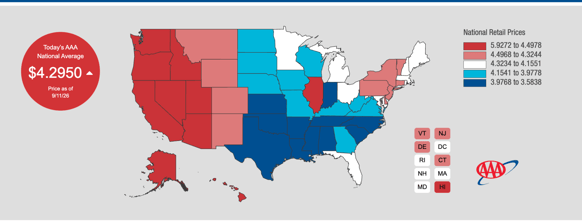
AAA’s U.S. map shows state gasoline-price differences.
Those variations matter for policymakers and campaign stakeholders. A national price increase may shape the broader affordability conversation, but the financial pressure is most immediate for households that drive long distances, depend on older vehicles, or live where fuel costs already run above the national average.
The price sign makes the effect visible. To understand why relief is often slow, however, readers need to look beyond the gas station and examine what makes up the price of a gallon.
A Gallon Reflects More Than One Decision
The U.S. Energy Information Administration identifies four major parts of a retail gasoline price: crude oil, taxes, refining costs and profits, and distribution and marketing. Crude oil is the largest component, which means international supply disruptions can raise prices even when U.S. drivers purchase fuel from a nearby station.
The other components help explain why prices differ by location. EIA reports that the federal gasoline tax is 18.4 cents per gallon. As of January 2026, state taxes and fees averaged 33.55 cents per gallon, while local taxes can add further variation. Refining costs also vary because regions use different fuel formulations and refineries use different types of crude oil and processing equipment.

What drivers pay for in a gallon of gasoline.
This structure means no single policy can control every part of the price. A state can change its tax policy, for example, but it cannot independently lower the global price of crude oil. Likewise, higher domestic production can help supply over time without preventing an immediate price response to disruption in global oil markets.
Those limits become sharper when refineries are already running near capacity. The next question is what public officials can realistically do when the fuel system has little short-term flexibility.
High Refinery Use Limits Quick Fixes
The EIA’s Weekly Petroleum Status Report shows that U.S. refineries operated at 97.8% of operable capacity in the week ending September 4, 2026, after reaching 98.0% the prior week. This measure tracks how much of the refining system is actively processing crude oil into products such as gasoline and diesel.
High utilization does not mean refineries cannot produce another gallon. It does mean the system has less unused capacity to absorb a new disruption, such as an outage, hurricane damage, or a further constraint on crude-oil supply. Reuters reported that the Labor Day price increase occurred as refineries operated near capacity and global supply concerns pushed crude-oil prices higher.
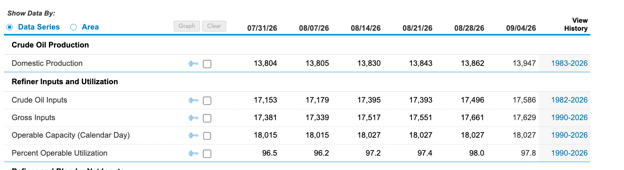
U.S. refinery utilization through September 4, 2026.
Public officials can take limited actions during a price spike, including adjusting fuel rules in narrow circumstances or managing emergency petroleum reserves. But those actions cannot guarantee a rapid return to lower prices when the underlying pressure comes from global crude-oil markets and a nearly fully used refining system.
That distinction is important for public debate. Gasoline prices are a real household concern, but they are not a simple scorecard for any one policy or officeholder.
What the Price Signals, and What It Does Not
Higher gasoline prices can squeeze household budgets quickly. They can also affect businesses that rely on cars, trucks, deliveries, farm equipment, or fuel-intensive services. Diesel matters especially because it helps move goods through supply chains; AAA reported a national diesel average of $6.0556 per gallon on September 11, its highest recorded average on the organization’s current tracker.
The current price increase gives policymakers a concrete affordability issue to explain. They should distinguish between actions that can provide limited or long-term relief and factors that arise from broader global energy markets. Clear explanations are more useful than promises that one announcement can reverse a price increase at the pump.
Gas prices are economic context, not direct proof of voter behavior. This article does not rely on polling that measures how fuel costs will affect the midterms. The evidence shows an immediate household expense and a visible political challenge, not a guaranteed electoral outcome.
Wrap Up
The price of gasoline remains one of the clearest ways Americans experience changes in the cost of living. At $4.295 per gallon nationally on September 11, regular gasoline cost households about $1.10 more per gallon than it did a year earlier.
That increase deserves attention because it reaches commuters, families, and small businesses quickly. At the same time, the price at the pump reflects global oil markets, regional supply systems, taxes, refining, and distribution costs that no single official can fully control.
The strongest public discussion recognizes both facts: higher fuel prices create a real affordability challenge, and durable relief requires an honest account of what drives the cost of a gallon.