Government Taxation, Spending, and Debt
Taxpayer-funded solar incentives may reward domestic factories, or merely finance the final step of imported production instead.
What to Know
- Blue wafers occupy a gray area between unfinished wafers and completed solar cells, complicating tariff and tax-credit rules.
- Lawmakers allege importers perform limited final processing in the United States to avoid duties and claim federal manufacturing credits.
- Deep Chinese dominance across Asian solar supply chains makes the true origin of imported products difficult for U.S. customs to trace.
- Existing duty rates vary significantly depending on the country and manufacturer, creating incentives to alter supply routes and product classifications.
- Tighter enforcement could protect taxpayers and domestic factories, but it may also increase solar project costs.
Federal policy is pursuing two goals. Tariffs protect domestic manufacturers from unfairly priced imports, while tax credits reward American production. The blue-wafer dispute asks whether limited domestic finishing can satisfy both systems and create durable industrial capacity.
Reuters reported that lawmakers asked customs and tax authorities to investigate partially finished solar products. They allege importers avoid duties, finish wafers domestically, and claim manufacturing credits. The allegation exposes a gap between classification and policy.
What Is a Blue Wafer?
A solar supply chain begins with purified silicon, which becomes an ingot and then a thin wafer. Additional processing turns the wafer into a functioning cell. Cells are assembled into modules for rooftops and utility projects.
Reuters described blue wafers as ultra-pure silicon slices that have undergone processing such as p-n junction doping and anti-reflective coating. They are more advanced than raw wafers but may arrive before becoming finished cells. That boundary affects duties and credits.
This distinction determines which companies owe duties and which qualify for taxpayer support. If minimal domestic work changes a product’s legal identity, companies may present imported value as domestic manufacturing, creating the alleged workaround.
How the Alleged Workaround Functions
The theory begins with importing a partly finished product rather than a completed cell. Final processing occurs in an American facility, supporting a domestic-origin claim. The sequence may avoid duties and create tax-credit eligibility.
Reuters reported that lawmakers asked U.S. Customs and Border Protection and the Internal Revenue Service to investigate the transactions. CBP determines origin and duty liability under substantial-transformation rules, while the IRS administers the Inflation Reduction Act’s Section 45X advanced manufacturing credits for qualifying domestic production. Because the agencies apply different legal tests, a partly finished import could potentially avoid cell duties and later qualify for a manufacturing credit after limited U.S. processing.
Investigators would need product specifications, processing records, origin documents, and tax filings. Lawful manufacturing and abusive avoidance may look similar without that evidence. The taxpayer issue becomes clearer when import scale is considered.
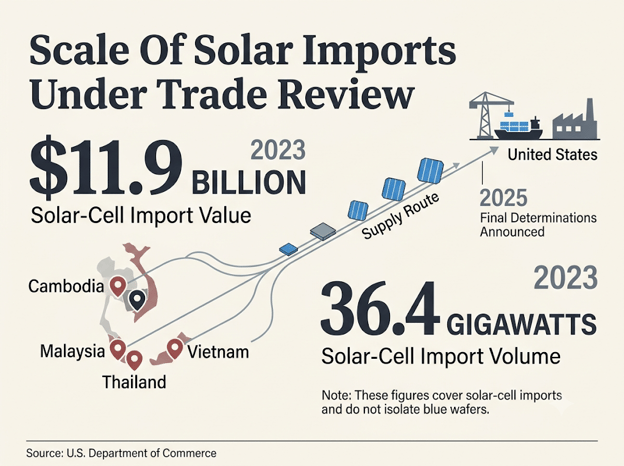
Four Asian Markets Supplied $11.9 Billion In Solar Imports. Created via Gemini.
The U.S. Department of Commerce examined cells from Cambodia, Malaysia, Thailand, and Vietnam in determinations announced in 2025. Its 2023 tables show 36.4 gigawatts of imports worth $11.9 billion. Those figures do not isolate blue wafers.
Taxpayer Cost
Manufacturing credits under Section 45X are intended to reward substantial American production. The blue-wafer dispute raises whether companies can claim those credits after limited domestic finishing, even when most of the product’s value was created abroad. In that case, taxpayer support may fund credit arbitrage rather than durable U.S. manufacturing.
The available sources provide no verified total for credits allegedly claimed through blue wafers, so they do not establish a proven multibillion-dollar loss. However, every improper claim reduces federal revenue and weakens incentives to build more complete domestic supply chains.
Budget integrity depends on defining meaningful transformation and enforcing it consistently. Rules rewarding only a final inexpensive step can direct money toward arbitrage. The deeper problem is continued dependence on foreign upstream production.
China’s Solar Supply Chain Dominance
Reuters reported that Chinese companies account for about 80% of global solar supply. Many shifted production into other Asian countries as U.S. tariffs expanded. That movement complicated enforcement without necessarily changing upstream control.
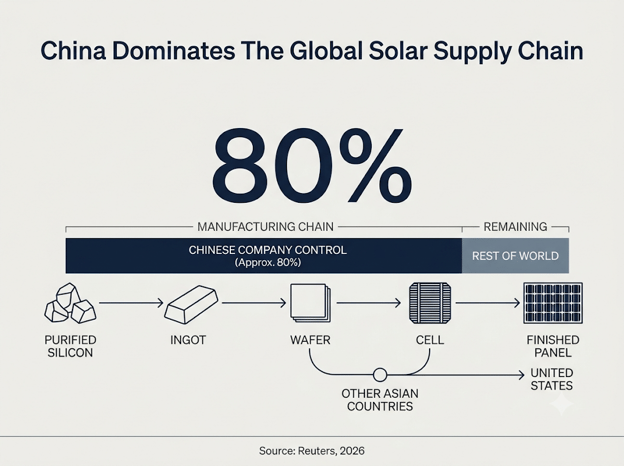
China Controls About 80% Of Global Solar Supply. Created via Gemini.
The U.S. Department of Commerce found affirmative dumping and subsidy cases involving four Southeast Asian countries. Rates varied sharply by producer and country. Commerce also found Chinese government subsidies benefiting companies in each investigated market.
Tariffs can redirect trade faster than they create a complete domestic supply chain. American factories still need wafers, equipment, workers, energy, and customers. Closing one loophole cannot solve those broader dependencies alone.
Enforcement Versus Project Costs
Stricter origin rules could make tariff collection and tax-credit eligibility reflect real manufacturing. Domestic producers would face less competition from subsidized imports. Taxpayers would gain clearer evidence that incentives are building durable capacity.
The counterargument is that restricting low-cost inputs can raise cell and module prices. Developers may delay projects, consumers may face higher installation costs, and utilities may pay more. Those consequences deserve consideration.
A workable rule should focus on meaningful processing rather than slogans. Agencies need standards, shared data, audits, and penalties for misrepresentation. Congress must decide how much short-term cost supports long-term industrial strength.
Wrap Up
The blue-wafer controversy does not prove every partially processed import is fraudulent. It warns that tariff categories and tax rules may reward different definitions of manufacturing. Enforcement must separate legitimate production from benefit-driven transactions.
Tax credits can build American factories when domestic work adds substantial value. They become harder to defend when taxpayers fund minor finishing attached to foreign-controlled supply chains. Clearer rules can protect incentives without banning foreign inputs.
Closing the loophole may raise costs while strengthening competition and budget integrity. Leaving it open may keep panels cheaper while weakening domestic capacity. Policymakers must decide which tradeoff offers more value.