
Legislative Issues
Artificial intelligence can sound certain even when its answers reflect hidden choices about accuracy, safety, ideology, and uncertainty.
What to Know
- The FTC proposes applying Section 5 of the FTC Act, 15 U.S.C. § 45, to undisclosed AI output steering that suppresses accuracy.
- The FTC cites a major AI developer reporting that consumers accept AI outputs without further fact-checking more than 90% of the time.
- The proposal distinguishes deliberate output steering from hallucinations caused by technical or resource limits, although misleading reliability claims could remain deceptive.
- Colorado laws SB 24-205 and SB 26-189 may conflict with the FTC’s approach when anti-discrimination requirements influence AI outputs.
- Public comments closed on July 31, 2026, following a 2-0 vote and direction from Executive Order 14365.
Americans increasingly use artificial intelligence for research, writing, advice, and decisions. Companies often present these systems as useful, accurate, or objective, although every model reflects choices about data, safety, tone, and acceptable outputs. The Federal Trade Commission is asking when those choices become deceptive marketing.
The proposal does not promise that regulators can identify one universally correct answer. It focuses on whether a company secretly steers a system away from objectives users requested or reasonably expected. That approach may protect consumers, but it raises the harder question of who defines accuracy when facts, values, safety rules, and uncertainty overlap. It also forces regulators to separate hidden manipulation from ordinary technical limitations.
What the Federal Proposal Would Do
The Federal Trade Commission issued the proposal on July 1, 2026, under Section 5 of the FTC Act, codified at 15 U.S.C. § 45, which prohibits unfair or deceptive acts or practices in commerce. The proposal responds to Executive Order 14365, signed on December 11, 2025, directing the FTC to explain how state laws requiring changes to accurate AI outputs may conflict with federal consumer-protection law. The announcement therefore forms part of a broader federal review of state AI mandates rather than creating a government-approved definition of truth.
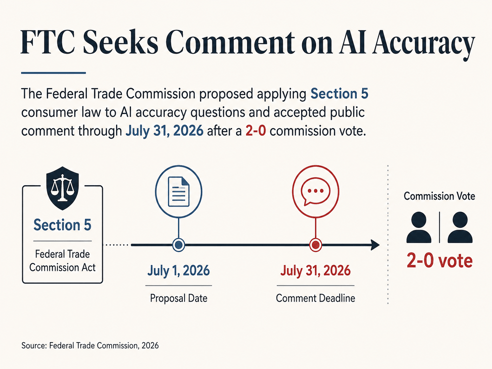
FTC Proposal Put AI Accuracy Under Review. Created via Gemini.
Under established FTC deception principles, regulators examine whether a representation, omission, or practice is likely to mislead a reasonable consumer and materially affect a decision. For AI systems, hidden steering would be material when disclosure of that objective could change whether a consumer buys, uses, or relies on the product. The proposed framework therefore asks whether a company markets a system as accurate, objective, or responsive to user goals while secretly directing its outputs toward a different priority.
Accuracy Is Not One Problem
AI systems can produce incorrect answers because their training data are incomplete, outdated, contradictory, or false. They may also misunderstand a request, generate unsupported details, apply a safety restriction, or follow a developer instruction. These failures do not all reflect intentional manipulation.
The Vectara Hallucination Leaderboard measures factual inconsistency when models summarize supplied documents rather than answer open-domain questions. Its May 11, 2026 results showed hallucination rates near 3%–5% for several stronger models and above 20% for some lower-performing models. Those figures provide a useful technical baseline, but they are not universal error rates because performance varies by model, task, prompt, and evaluation method.
The FTC proposal distinguishes technical hallucinations from deliberate, undisclosed steering toward objectives users did not request or reasonably expect. The Commission states that hallucinations caused by technological or resource limitations do not, by themselves, create an issue under Section 5, although misleading claims about their likelihood may still be deceptive. Harder cases arise when safeguards, developer priorities, or legal requirements intentionally alter an answer without adequate disclosure, forcing regulators to compare company promises, user expectations, and design choices.
Who Gets to Define Accuracy
The Federal Trade Commission claims authority to police deceptive representations, not certify one official version of truth. Under Section 5, regulators would ask whether an AI company secretly prioritized another objective while marketing its system as accurate, neutral, or responsive to users. Enforcement would still require judgments about whether hidden steering displaced accuracy strongly enough to affect a consumer’s decision to use or purchase the system.
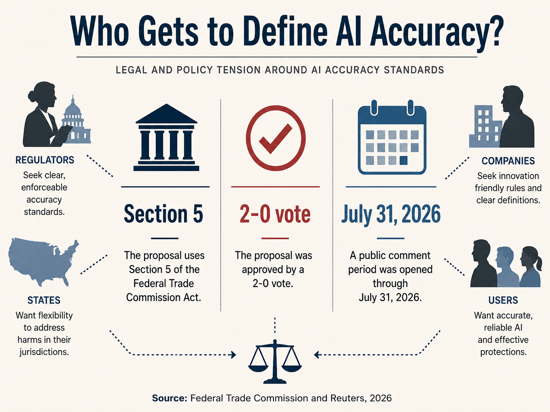
Regulators, States, Companies, And Users Contest Accuracy. Created via Gemini.
Colorado’s SB 24-205 required developers and deployers of high-risk AI systems to use reasonable care to protect consumers from known or foreseeable risks of algorithmic discrimination. Its requirements included risk-management programs, impact assessments, consumer notices, data-correction rights, and opportunities to appeal certain consequential decisions. SB 26-189 replaced that framework with updated duties covering automated decisions involving education, employment, housing, lending, insurance, health care, and essential public services.
The FTC argues that state anti-discrimination duties do not excuse undisclosed steering that conflicts with users’ reasonable expectations. If complying with a state rule causes a company to alter outputs without clear disclosure, the Commission says Section 5 may apply and the conflicting state requirement may be impliedly preempted. That remains the FTC’s legal theory rather than a settled court ruling, leaving courts and lawmakers to determine whether federal consumer-protection law overrides particular state AI safeguards.
What Consumers Should Expect
Consumers cannot inspect training data, hidden instructions, safety policies, or internal priorities before asking an AI system a question. They usually see a confident answer and a broad promise that the system will provide useful or accurate results. Clear information about major limits, competing objectives, and refusal policies would help users choose tools that match their needs.
The FTC proposal does not establish a formal safe harbor, but it explains how companies may reduce deception risk through adequate disclosures. Companies should clearly and conspicuously disclose when their systems prioritize objectives such as safety, legal compliance, or other developer goals over the answer a user requests. The disclosure must be prominent enough to change reasonable expectations rather than buried in terms of service or shown only once.
The FTC also indicates that stronger departures from expected accuracy require more persistent and prominent disclosures. Policymakers must still avoid punishing ordinary uncertainty, technical limitations, legitimate cybersecurity protections, or clearly disclosed safety constraints. The practical question is whether companies honestly tell users what their systems are designed to prioritize and when those priorities may shape an answer.
Wrap Up
The proposal applies established consumer-protection principles to AI systems marketed as accurate, neutral, or responsive to users. Companies may risk Section 5 liability when they secretly steer outputs toward other objectives while allowing consumers to believe accuracy remains the primary goal. The FTC’s proposed disclosure standard offers a practical response by requiring clear, conspicuous, and sufficiently persistent notice when non-accuracy objectives influence model behavior.
The unresolved issue is how regulators will distinguish hidden manipulation from technical error, lawful restrictions, and openly disclosed design choices. The proposal does not allow one agency to certify an official truth, but it could influence how companies describe safety filters, compliance requirements, and other priorities. Courts, lawmakers, regulators, companies, and users will ultimately shape how much disclosure is enough to preserve trust in AI-generated answers.