
Legislative Issues
America’s race to expand artificial intelligence capacity is colliding with communities that see the infrastructure’s local costs more clearly than its national benefits.
What to Know
- About 70% of Americans oppose data center construction in their community
- Opposition rose from 42% in December 2025 to 63% by July 2026
- At least $170 billion across 46 projects in 20 states was publicly delayed or cancelled between January 2024 and May 2026
- Data centers could account for more than 40% of U.S. electricity demand growth over the next five years
- New York enacted the nation's first statewide hyperscale data center moratorium in 2026, while Texas ordered a grid connection audit instead
Google searches for "data center" are running roughly 3.5 times higher in 2026 than in 2025, and almost 10 times higher than in 2024. What was once a niche zoning dispute has become one of the fastest-moving political stories of the year, showing up in Democratic primary debates in Wisconsin and Michigan and prompting a first-in-the-nation moratorium in New York.

Nate Silver, Statistician and Founder, Silver Bulletin

Jasmine Sun, Independent Journalist
A conversation between Nate Silver and Jasmine Sun, published August 17, 2026, offers one of the clearest on-the-ground accounts of why. Sun spent roughly three weeks reporting from Wisconsin and Michigan, and what she found complicates the assumption that Americans simply fear artificial intelligence. Paired with polling from Republican strategist Patrick Ruffini and a growing body of research on blocked projects, the picture that emerges is less about the technology itself and more about who controls the decision to build it.
Why Communities Are Turning Against Construction, Not the Technology
Sun's reporting found that residents were far angrier at local elected officials than at the AI companies themselves. Frustration centered on the sense that a city council or mayor had privately agreed to a deal before residents had any say in it, more a story of local corruption than of chatbot anxiety.
Sun described what she heard from activists in Wisconsin and Michigan as centered on betrayal by local government rather than fear of the technology.

Patrick Ruffini, Co-Founder, Echelon Insights
That framing lines up with the numbers. Ruffini's Echelon Insights survey from June 2026 found voters opposed a data center in their own community by 62% to 27%, with nearly half strongly opposed, tracking closely with Gallup polling showing roughly 70% national opposition. Ruffini, writing for a conservative audience, argued the questions residents are asking, about electricity bills, grid strain, and who absorbs the land use burden, are legitimate rather than reflexively anti-growth.
NDAs and the Collapse of Municipal Trust
Much of the anger traces back to a specific practice. Data center developers frequently run a competitive, multi-city site selection process, similar to Amazon's HQ2 search, and use nondisclosure agreements to keep towns from comparing notes or tipping off farmland owners before a sale closes. Public Citizen's research frames NDA use as a structural feature of state-level deal making that blocks basic public oversight.
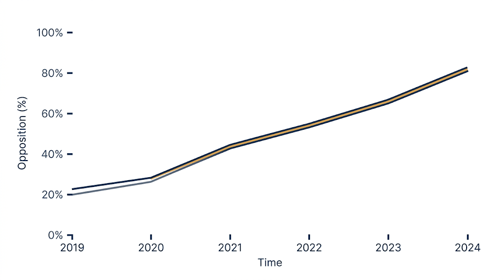
Opposition to local data center construction nearly tripled in eighteen months. Created via Gemini.

Richard Blumenthal, U.S. Senator, Connecticut
Senator Richard Blumenthal's office has pressed for disclosure on similar grounds, tying the secrecy directly to unexplained grid and rate impacts. Even developers now regret the practice. Sun reported that pro-development sources, including building trades leaders, told her NDAs made backlash worse because officials could not correct rumors once they started spreading. Microsoft has since ended NDA use with local governments as a stated policy, a reversal cited directly in the Silver Bulletin conversation and now referenced by other developers as an early model for how to negotiate without triggering the same backlash.
A Democratic Coalition Splitting Down the Middle
Construction unions and environmental progressives have historically voted together. Data centers are pulling them apart. Building trades workers described a genuine boom to Sun, with per diem pay reaching roughly $700 a week in competitive labor markets and apprenticeship programs doubling in size, while environmental and progressive activists are leading most moratorium efforts, citing grid strain and water use.
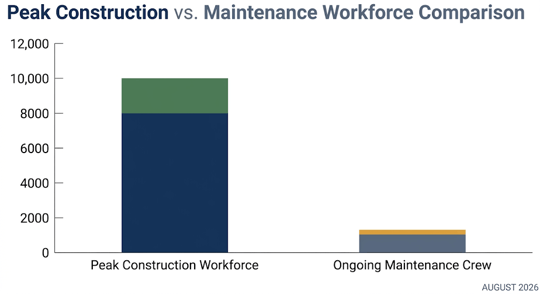
Ten thousand construction jobs shrink to a small crew. Created via Gemini.
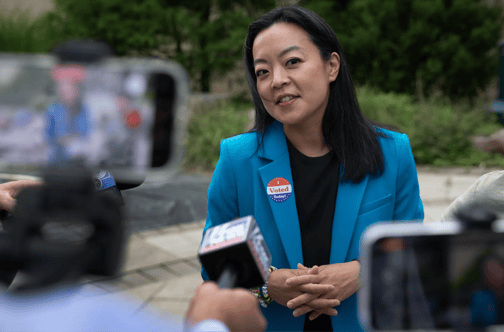
Francesca Hong, Wisconsin Gubernatorial Candidate, 2026 Democratic Primary
Wisconsin's 2026 gubernatorial primary made the split visible. Only Francesca Hong, among the Democratic candidates, backed a data center moratorium, a position reporting ties partly to rivals not wanting to alienate the skilled trades vote.
The jobs themselves are also a source of tension. Microsoft's Mount Pleasant, Wisconsin campus required up to 10,000 workers during its multi-year construction phase before staffing dropped to a small maintenance and security crew, a pattern communities increasingly weigh against the promise of permanent local employment.
Grid Strain Is Pulling the Fight to Washington
Physical limits are now converting local political friction into federal legislative risk. Data centers could more than double their electricity use by 2030 and drive over 40% of U.S. electricity demand growth over the next five years, according to Lawrence Berkeley National Laboratory research cited by Ruffini.
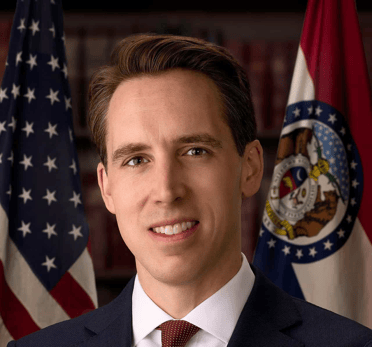
Josh Hawley, U.S. Senator, Missouri
That strain is no longer a local story alone. Senators Josh Hawley and Blumenthal introduced the bipartisan GRID Act in February 2026, which would require new data centers to source power independently of the public grid and publicly disclose their electricity usage, with a ten-year transition window for existing facilities. Its bipartisan authorship signals that ratepayer and transparency concerns first raised in town halls have reached the Senate floor.
Nearly 46 projects worth $170 billion stalled in two years. Created via Gemini.
Carbon Direct's analysis, covered by Route Fifty, found at least $170 billion across 46 projects in 20 states publicly delayed or cancelled between January 2024 and May 2026, with lack of transparency, including NDA use and undisclosed water and power needs, cited as the leading cause. Brookings researchers caution that blanket moratoriums are a blunt instrument rather than a substitute for structured oversight, a tension playing out directly between New York's new statewide pause and Texas's narrower grid audit approach.
Wrap Up
Opposition to data centers looks like a referendum on artificial intelligence, but the underlying evidence points somewhere else. Residents in Wisconsin and Michigan told researchers their frustration was with closed-door deal making and unaccountable local government, not with chatbots or model capability. NDAs, more than any environmental or technological complaint, appear to be the single biggest driver of the backlash documented so far.
Coalition politics make this especially unstable heading into the midterms, and the fight is no longer confined to town halls. Building trades unions and environmental progressives, longtime allies within the Democratic Party, now sit on opposite sides of nearly every data center fight in the country, while a bipartisan Senate bill shows Washington treating ratepayer and disclosure concerns as serious enough to legislate.
The physical numbers set the actual ceiling on how long this fight can stay purely political. $170 billion in delayed or cancelled projects and a looming grid capacity crunch mean transparency reforms, Community Benefits Agreements, and independent on-site power sourcing will need to move faster than moratorium adoption, or capital and construction will simply shift to Canada, Australia, or the Gulf states already positioning themselves as contingency sites.