Financial Literacy
A retirement wave is about to transfer trillions in small business wealth, and most of it has nowhere to go.
What to Know
- Between 2.3 and 3 million boomer-owned small businesses will need new owners this decade
- Fewer than 1 in 4 owners have a formal succession plan in place
- Over $10 trillion in small business assets are changing hands as boomers retire
- Worker ownership funds grew 73% to roughly $865 million in 2025
- More than 1 in 6 workers at boomer-owned businesses risk losing their jobs if no buyer steps in
Baby Boomers built a remarkable share of America's small business economy, and now they are all leaving at once. Old National Bank's 2026 research estimates between 2.3 and 3 million boomer-owned small and medium businesses will transition ownership over the next decade, a generational handoff so large economists call it the Silver Tsunami. For workers employed at those businesses, the question is not abstract: no buyer means no job.
Most owners are not ready for this moment. Project Equity's research shows fewer than one in four boomer business owners have a formal succession plan, and many have no plan at all. A business without a plan does not get sold at a fair price. It closes.
Why No Buyer Shows Up
Selling a small business is harder than it looks. Traditional buyers, whether private equity, strategic acquirers, or individual entrepreneurs, are selective, and most local businesses do not clear the return thresholds those buyers require. A profitable plumbing company or regional logistics firm may support thirty workers and generate reliable income, but that does not make it an attractive deal for a fund seeking high multiples. The pool of buyers who understand local markets and are willing to pay a fair price is genuinely thin.
The problem compounds when an owner waits too long. Businesses that go to market in distress, because the owner is already retired or in declining health, command lower valuations and attract fewer interested parties. McKinsey's February 2026 analysis estimates that by 2035, about six million small businesses will face ownership transitions, with over one million representing highly viable candidates for a productive sale or employee transfer.
What Employee Ownership Actually Does
Employee ownership models give workers the ability to buy the business from a retiring owner, preserving jobs, keeping profits local, and giving the seller a legitimate exit at fair value. The two most common structures are Employee Stock Ownership Plans, known as ESOPs, where a trust holds shares on behalf of workers, and Employee Ownership Trusts, which use a different financing structure but accomplish a similar result. Neither requires workers to write a personal check on day one.
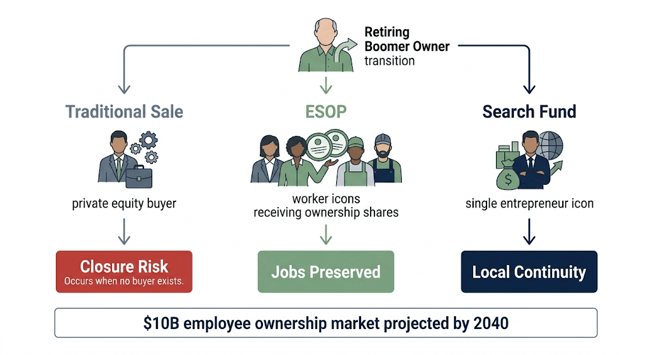
Worker ownership funds surged 73 percent to 865 million. Created via Gemini.
Ownership Capital Lab's March 2025 report frames the Silver Tsunami as a once-in-a-generation opening to scale employee ownership across the United States. The organization projects the employee ownership fund market could reach $10 billion by 2040 if current momentum holds. Investment in these funds already surged 73% in 2025 alone, reaching roughly $865 million, according to Harvard Business School research published in March 2026.
Search Funds Fill Another Gap
Not every business is right for employee ownership, and that is where search funds enter. A search fund is a vehicle that allows a small group of investors to back an individual entrepreneur, called a searcher, who identifies, acquires, and operates a small business. For a retiring owner, a searcher represents a motivated buyer who intends to run the company rather than strip it. For the local economy, it means continuity rather than closure.
Harvard Business School's October 2025 analysis notes that search funds and employee ownership models are increasingly seen as complementary tools rather than competing ones. Each addresses a different type of business and a different seller profile.

Patrick Gouhin, CEO, Angel Capital Association
Patrick Gouhin, CEO of the Angel Capital Association, told researchers:
"The biggest risk is that owners wait until they have no options left. A plan made five years out produces a completely different outcome than one made five months out."
Search funds are still a small corner of the private capital market, but interest is growing precisely because the Silver Tsunami has made the supply of available businesses far larger than the pool of traditional buyers. For workers and communities, that gap is where the real financial risk lives.
Wrap Up
What happens to these businesses matters well beyond the owners themselves. Workers lose jobs, communities lose anchor employers, and local tax bases shrink when a profitable small business closes because no one could structure a transition in time. Employee ownership and search funds both exist to prevent exactly that outcome.
Workers at boomer-owned businesses do not need to wait for a policy solution. Asking ownership questions early, understanding whether an ESOP structure is available, and connecting with local Small Business Development Centers are concrete steps that cost nothing but time.