Legislative Issues
America’s AI race now depends on the workers who build power, data centers, fiber, and trust.
What to Know
• The United States holds only a 6 to 7 month frontier AI lead over China.
• AI leadership depends on electricity, data centers, transmission, and fast permitting.
• New interstate transmission can take 5 to 10 to 15 years to permit.
• Meta says data center construction has supported about 45,000 skilled trades since 2011.
• A $115 million workforce academy is training electricians, plumbers, and fiber technicians.
Energy Imperatives Summit Day 2, source discussion on AI, permitting, and the skilled trades workforce behind the buildout.
At the Energy Imperatives Summit Day 2, the Power AI panel made one point clear. Artificial intelligence may look digital to users, but its future depends on physical systems that must be financed, permitted, built, powered, and maintained.
That makes the AI boom a trades story as much as a software story. The winners will include model builders, but also electricians, plumbers, fiber technicians, construction crews, grid operators, and communities that can turn industrial plans into working infrastructure.
AI Race Runs on Electricity
On the summit’s China and AI discussion, Ryan Fedasiuk of the American Enterprise Institute framed the competition through 4 dimensions. Those were frontier capability, national adoption, international diffusion, and social resilience to AI disruption.
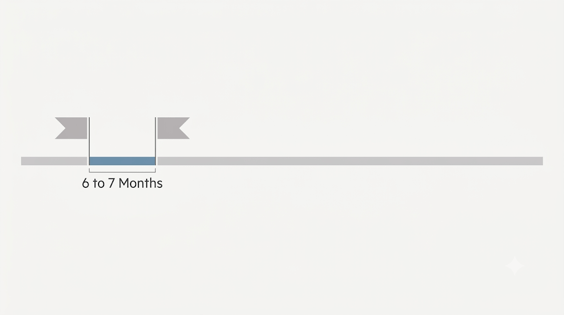
A six month lead is a moving target, not a wall. Created via Gemini.

Ryan Fedasiuk, American Enterprise Institute
Ryan Fedasiuk explained how narrow the frontier lead still is.
“The United States has a decisive lead of about six to seven months.”
That statement shows why infrastructure speed matters. A 6 to 7 month lead is not a permanent moat. It is a moving advantage that depends on how quickly America can turn investment into compute.
Fedasiuk said the real question is who will have the energy to run AI services at scale. In practical terms, that means electricity, data centers, chips, and devices that turn electricity into tokens.
China has advantages in national adoption because AI is a state priority. Local governments can offer compute credits, push installations, and align policy around rapid deployment. America has stronger companies, capital markets, research depth, and energy resources, but those advantages matter only if projects can move.
Permitting Becomes AI Policy
A model can improve in months. A transmission project can take years. That mismatch is now one of the central risks in the AI race.
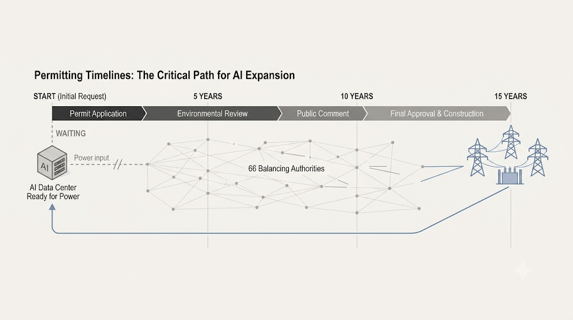
Transmission delays can slow AI power. Created via Gemini.

Marsden Hanna, Head of Energy and Sustainability Policy at Google
Marsden Hanna tied the AI upside directly to energy during the Power AI panel.
“We don't get that upside if we don't have the energy to power it.”
That statement matters because the bottleneck is not imagination. It is execution. Google, Meta, Anthropic, and other hyperscalers are looking for ways to connect data centers to reliable power without weakening the grid or raising household bills.
Hanna said the United States has 66 different balancing authorities. He also said new interstate transmission can take 5 to 10 to 15 years to permit, while litigation can send a project back to the beginning after years of work.
That is why permitting reform is no longer only an energy issue. It is AI policy, workforce policy, and competition policy. If America cannot build lines, generation, and interconnection capacity fast enough, it can lose the benefits of private investment before the first server turns on.
Skilled Trades Power the AI Buildout
On the Power AI panel, Patrick Ryan, Principal Energy Strategy at Meta, described what the AI buildout already means for the trade workforce. Meta has 32 data centers globally, including 28 in the United States across 23 states. Since 2011, those projects have supported about 45,000 skilled trade roles.
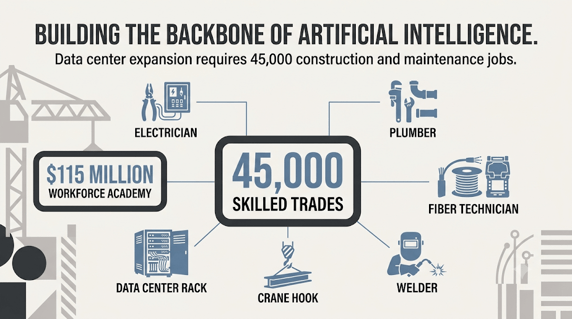
Skilled trades are building AI infrastructure. Created via Gemini.
Patrick Ryan, Principal Energy Strategy at Meta
Patrick Ryan described how the workforce academy reduces barriers for trainees.
“We cover kind of all transport, provide a stipend and then guarantee a job at the end of it.”
The academy has a $115 million first year commitment to train electricians, plumbers, and fiber technicians. Ryan said it is being piloted in Louisiana, Ohio, Indiana, and Texas.
This is the strongest household argument for the AI boom. The revolution is not only for coders. It also needs electricians who wire equipment, plumbers who support cooling systems, fiber technicians who connect facilities, and construction crews who build the sites.
That creates a path for workers without a four-year computer science degree. A young person can enter a trade, gain a credential, and help build the physical system behind AI. If the training pipeline works, technology growth can become a blue-collar wage story. For parents, that means AI can point toward apprenticeship, certification, and steady work, not only toward distant fears about automation replacing office jobs in places where families already live and work.
Local Trust Can Decide the Race
Infrastructure is not built by capital alone. It also needs local consent. Communities are asking fair questions about power bills, water use, land, noise, tax revenue, and whether promised benefits will stay nearby.

Community trust is harder to build than a substation. Created via Gemini.
Fedasiuk warned that malicious actors in China are reportedly using AI platforms to generate misinformation about data center energy consumption. The goal is to spread narratives that data centers will damage communities, drain water, hurt the environment, or impose local costs.
That threat matters because misinformation does not need to win a national debate. It only needs to slow permits, harden local opposition, and make officials afraid to approve projects.
The answer cannot be slogans. Companies have to show their math. They must explain how projects pay their own way, add generation, protect ratepayers, create training pathways, and support local services.
Ratepayer protection was a major theme in the summit discussion. Large load tariffs, long-term commitments, minimum demand charges, exit fees, collateral, and new generation were discussed as tools to keep ordinary households from absorbing hyperscaler costs.
A data center should not look like a fenced box that consumes power and exports profit. It should look like an infrastructure bargain. The community gets jobs, taxes, training, grid upgrades, and accountability. The company gets power, speed, and local trust.
Building Capacity Builds Prosperity
The AI economy will reward places that can build. That does not mean ignoring legitimate concerns. It means answering them early, clearly, and with enforceable commitments.
America’s advantage is that it still has energy resources, industrial talent, capital, and a private sector capable of moving fast. Its weakness is that planning and permitting can turn urgency into delay. In a race measured in months, delay becomes strategy by default.
Skilled trades matter because they turn policy into reality. A permitting bill does not connect a substation. A capital budget does not pull fiber. A model release does not install cooling. Workers do.
That is why the next American economy should not separate technology from trades. The AI boom needs both. Coders build models. Skilled workers build the world those models require. That bridge matters because trust often begins with visible work, local hiring, accountability, and community pride.
Wrap Up
America’s AI lead is real, but it is not guaranteed. A 6 to 7 month frontier advantage can vanish if China deploys faster, builds faster, and turns infrastructure into national power. The country does not need to choose between AI and workers. The better path is to connect them. Data centers, transmission, power plants, and fiber networks can create durable work for electricians, plumbers, technicians, welders, operators, and builders.
The next big winners in tech may not all write code. Many will wear hard hats, build the grid, and make the AI boom real at home.