Social Security
Social Security’s 2032 Deadline: What Younger Americans Need to Know
Social Security will not disappear when its retirement trust fund is depleted, but delayed reforms...
The retirement trust fund is projected to be depleted in 2032, and every American collecting benefits faces an automatic cut unless Congress acts before the deadline.
Franklin D. Roosevelt, 32nd President of the United States, signed Social Security into law in 1935.
Social Security was signed into law in 1935 to protect Americans against what Franklin D. Roosevelt called "poverty-ridden old age." Nearly a century later, the program that more than 71 million Americans depend on is running out of trust fund reserves. The retirement trust fund is now projected to be depleted in 2032, and when it is, every recipient, regardless of income or wealth, faces an automatic benefit cut under current law. The issue starts with the latest Trustees Report data showing how fast the deadline is approaching, then moves through Congressional Budget Office projections showing how deep the cuts could be, the debate over six-figure benefits for wealthy retirees, and the reform proposals that could prevent the cliff if Congress acts.
The 2026 Trustees Report delivered a deadline that sounds manageable at first. Social Security's retirement trust fund is projected to be depleted in 2032, one year earlier than last year's estimate. Behind that date is a trust fund outlook that worsened from official projections just one year ago. The 75-year funding shortfall jumped from $26.1 trillion to $30.3 trillion, and full benefits remain payable only until reserves are depleted. The report confirms that Social Security still has time for a managed fix, but that margin shrinks with every year Congress delays.
The demographic math driving the shortfall is structural and accelerating. In 1960, there were more than 5-to-1 workers paying into the system for every beneficiary. Today that ratio has fallen to 2.9-to-1, and it is projected to fall to 2.2-to-1 by the 2070s. The fertility rate assumption was revised downward from 1.9 to 1.75 children per woman, meaning fewer future workers will be available to support a growing retiree population. At the same time, the payroll tax now reaches only 83% of covered wages, down from 90% in 1983, because higher-income earners' wages have grown faster than the taxable maximum of $184,500.
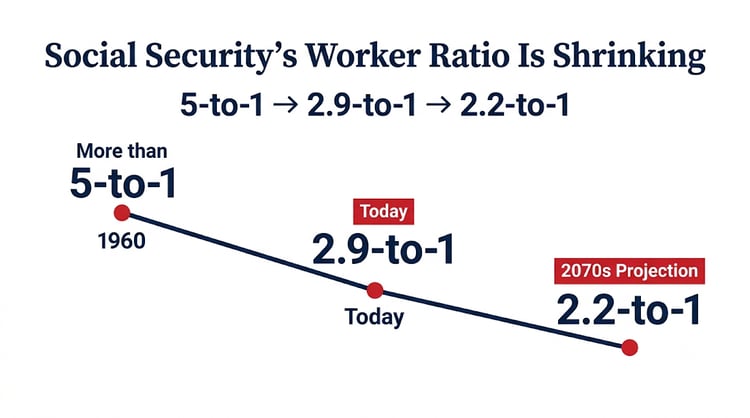
Social Security has fewer workers supporting each beneficiary, falling from more than 5-to-1 in 1960 to 2.9-to-1 today.
When the trust fund is exhausted in 2032, the program does not shut down, but it can only pay out what it collects in real time through payroll taxes. Under current law, that means an automatic 22% cut to every recipient's benefits, regardless of income, age, or need. A retired couple receiving average benefits would lose roughly $10,600 per year, while an average non-disabled widow or widower receiving around $1,800 per month would lose approximately $4,800 per year. That difference between scheduled benefits and payable benefits is where the next part of the crisis becomes unavoidable.
Social Security's next major deadline is not a vague future problem. It is 2032, when the Congressional Budget Office projects the Old-Age and Survivors Insurance Trust Fund, or OASI, will be exhausted. The Trustees project trust fund exhaustion in 2032, and the CBO projects OASI will also be exhausted in 2032. The larger concern is what happens after depletion. CBO's payable-benefits scenario shows a 7% cut in 2032 and an average 28% cut from 2033 to 2036.
Trust fund exhaustion does not mean Social Security disappears. Payroll taxes would still come in, and benefits would still be owed. The problem is that current law does not allow full scheduled benefits to be paid from empty reserves. CBO's standard baseline assumes full payments continue for budget modeling, but under current law, there is no legal authority to keep paying full scheduled benefits from an exhausted trust fund. That is why promised benefits and payable benefits are not the same thing once the trust fund reaches zero.
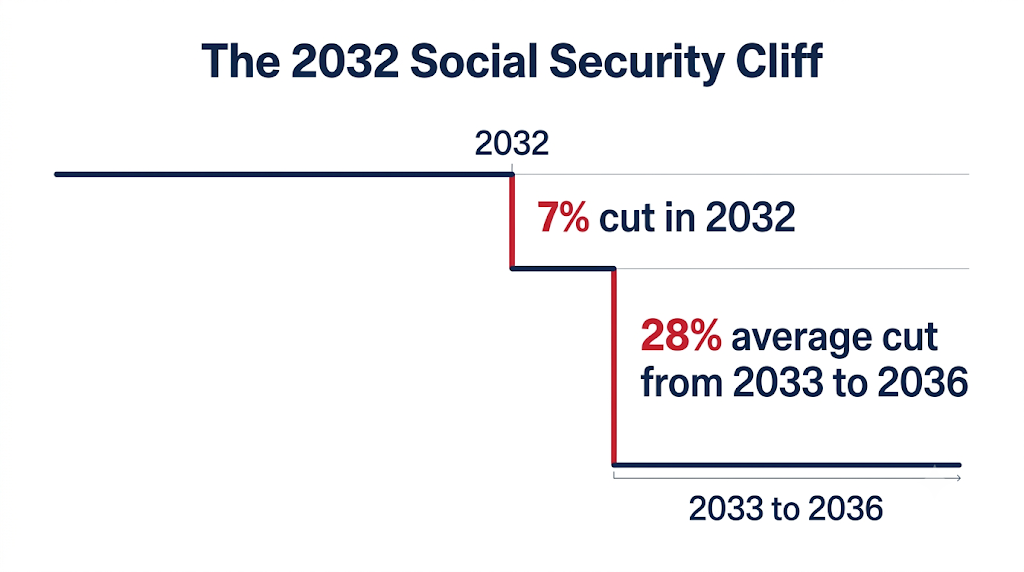
CBO’s payable-benefits scenario shows a 7% cut in 2032 and an average 28% cut from 2033 to 2036.
The scale of the problem is driven by a demographic wave that has been building for decades. The number of Americans aged 65 and older is now almost 3 times what it was 50 years ago and is expected to rise by about 15% over the next decade. Social Security beneficiaries are projected to grow from 71 million in 2026 to 82 million in 2036. The program faces pressure from more retirees, slower workforce growth, and benefits growing faster than dedicated revenue. Waiting until 2032 would leave Congress facing sharper benefit cuts, larger tax increases, more borrowing, or some combination of all three. The cliff is not only about whether benefits continue. It is also about who should bear the cost of preventing the automatic cut.
Social Security's first monthly benefit check was $22.54, roughly $400 in today's dollars. Franklin D. Roosevelt designed the program as a floor beneath the poorest retirees, not a six-figure annual payout for millionaire couples. Nearly a century later, couples who earned at or above the taxable maximum of $184,500 for at least 35 years can collect over $100,000 in annual Social Security benefits. Meanwhile, the program is six years away from insolvency and has been drawing down its trust fund every year.
The fiscal contradiction is matched by a household one. When the trust fund is exhausted in 2032, current law triggers an automatic 24% across-the-board benefit cut, hitting every recipient regardless of wealth. For a 60-year-old couple retiring at that moment, that cut equals $18,400 in lost income in their first year. For low-income retirees who depend on Social Security as their primary income source, a 24% reduction is not an inconvenience. It is a financial emergency. Yet households with average wealth of at least $65 million can still receive six-figure payouts from the same program.
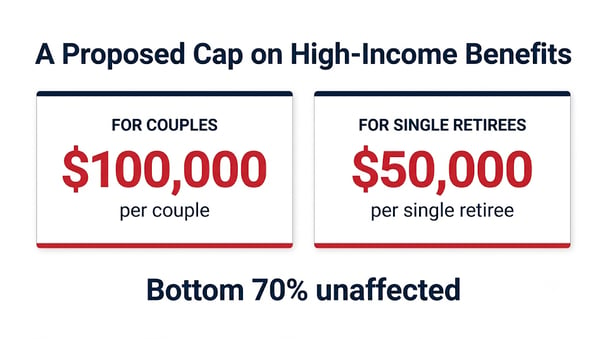
A proposed benefit cap would leave bottom 70% unaffected. Created via Gemini.

Maya MacGuineas, President of the Committee for a Responsible Federal Budget.
Maya MacGuineas, President of the Committee for a Responsible Federal Budget, has proposed a straightforward fix. Cap annual benefits at $100,000 per couple and $50,000 per single retiree. Depending on how the cap is indexed over time, it could close between one-fifth and one-half of Social Security's entire solvency gap while leaving the bottom 70% of households completely unaffected. 80% of households would see a benefit increase relative to what current law requires after reform because a managed cap would reduce the need for an automatic 24% cliff cut. The debate is not only about math. It is about whether changing benefits for high earners weakens the earned-benefit structure that made Social Security politically durable.
The means-testing debate may appear straightforward. Stop paying wealthy retirees six-figure benefits and the solvency problem shrinks. But the counterargument is rooted in how Social Security was built. Franklin D. Roosevelt did not design Social Security as charity. He built it as a contract, where workers paid in across their careers and collected what they had earned when they retired. In 1941, Roosevelt said payroll contributions gave workers "a legal, moral, and political right to collect their pensions."
That foundation is now under fiscal pressure. Social Security's costs have exceeded its dedicated payroll-tax revenue every year since 2010. Washington is on track to draw down the retirement trust fund by more than $200 billion in 2026 alone. Without changes, the trust fund exhausts its reserves by 2032. At that point, incoming payroll tax revenue covers only about 76 cents of every dollar owed, triggering an automatic 24% benefit reduction for every retiree in America, regardless of income, wealth, or need.

Two Social Security paths: 24% cliff cut or 6% shared reduction. Created via Gemini.

Brenton Smith, former adviser on Social Security at The Heartland Institute.
Brenton Smith, a former adviser on Social Security at the Heartland Institute, argues that breaking the payroll-tax-to-benefit link would change Social Security from the program Roosevelt envisioned. His concern is not that wealthy retirees need the money. His concern is that once Congress breaks the link between payroll taxes withheld and benefits received, every future budget crisis becomes an opportunity to redefine who qualifies and at what level. What begins as a cap on couples worth $65 million may not stay there. Over a 30-year freeze on a $100,000 cap, inflation erosion would reduce the real purchasing power of that ceiling to approximately $43,000 by the 2060s, pulling middle-class retirees into means-testing territory they did not anticipate.
A different path would cut smaller now rather than larger later. Smith's alternative would impose a 5% limit on annual trust fund drawdowns immediately. That translates to a 6% across-the-board benefit reduction for all recipients, shared proportionally rather than concentrated on one group. Pairing that reduction with a strengthened Supplemental Security Income program would protect low-income retirees through a need-based system already designed for that purpose. A 6% shared reduction now is smaller and more gradual than waiting for the 24% cliff in 2032. That tension between arithmetic and politics is the core of Social Security's reckoning.
Social Security's retirement trust fund is projected to be exhausted in 2032, and the trajectory is worsening. The 75-year funding shortfall jumped from $26.1 trillion to $30.3 trillion in a single year. The demographic forces driving the crisis are structural. Fewer workers are supporting more retirees, fertility assumptions have been revised downward, and the payroll tax reaches a shrinking share of covered wages compared with 1983. When the trust fund runs out, current law does not shut the program down. It triggers an automatic benefit cut of 22% to 24% for every recipient, depending on the projection. The CBO projects that cuts could reach an average of 28% from 2033 to 2036 as the shortfall deepens. For the more than 71 million Americans who depend on Social Security today, and the millions more who will join them, the cliff is not a political talking point. It is a deadline.
The reform debate comes down to two competing approaches. One side argues that wealthy retirees collecting over $100,000 in annual benefits from a program designed for poverty protection should be capped, a change that could close between one-fifth and one-half of the solvency gap while leaving the bottom 70% of households unaffected. The other side argues that breaking the contributory contract that has protected Social Security for 90 years would weaken the political coalition that keeps the program alive. The shared-sacrifice alternative, a 6% across-the-board cut enacted now, would reduce the need for a 24% cliff cut in 2032 and could be paired with expanded SSI payments to shield the lowest-income retirees. Every year Congress delays, the eventual fix becomes larger and more disruptive. The deadline continues to approach unless Congress acts.

Social Security will not disappear when its retirement trust fund is depleted, but delayed reforms...
.jpg?width=300&name=image%20(2).jpg)
A new estimate points to a larger benefit increase in 2027, but the official result and retirees’...

Temporary premium support is ending, testing whether pricing brings discipline or exposes retirees...