AI Infrastructure, Fiscal Policy
Why an American Battery Startup Built Its First Factory in China
EnerVenue’s move from a planned Kentucky factory to China shows that advanced manufacturing depends...
Every dollar Washington collects, cuts, or protects reflects a choice about who benefits and who pays, and those choices in tax policy, fraud oversight, subsidies, and new spending programs are reshaping how much fiscal room the country has left.
Every federal budget is a set of choices made under pressure, and those tradeoffs rarely make headlines the way a new spending bill does. A fraud crackdown can recover real money while also serving a political narrative that obscures deeper program cuts. A temporary subsidy can shield a program from disruption while creating a cliff the moment it ends. A tax cut can win votes across party lines while adding trillions to a deficit no one has a plan to close, and a new spending program still has to compete for room inside a budget that is already stretched thin. Oversight, subsidies, taxation, and new federal commitments all draw from the same constrained pool, which is why this page tracks these pressures as they play out in real fiscal decisions rather than as abstract debates over deficits and debt.
The Government Accountability Office estimates the federal government loses between $233 billion and $521 billion annually to fraud, roughly 3 to 7% of all federal spending obligations. Health care programs carry an outsized share of that exposure. HHS Office of Inspector General reported Medicaid Fraud Control Units secured 1,185 convictions in fiscal year 2025, recovering nearly $2 billion and returning $4.64 for every dollar spent on enforcement, evidence that fraud recovery is one of the rare areas of government spending with a clearly measurable return.
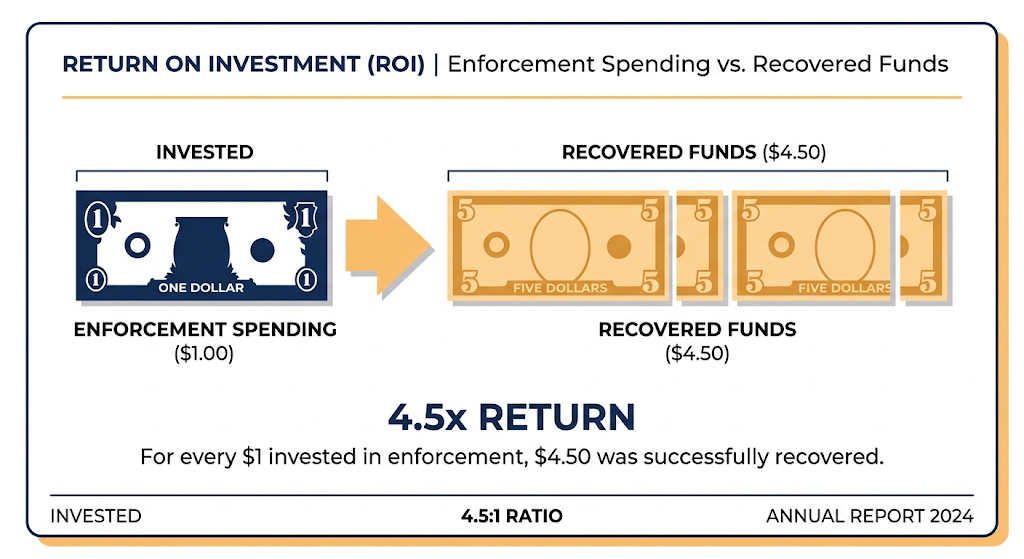
Enforcement spending returns several times its cost. Created via Gemini.
Yet the scale of the fraud problem is often overstated by conflating it with paperwork errors. CMS reported 77% of Medicaid's flagged improper payments in fiscal year 2025 traced to insufficient documentation, not confirmed theft, a distinction the agency itself stresses matters for how the scale of the problem gets described publicly. Minnesota has become the administration's central showcase for the fraud narrative, and the underlying cases are real. Since 2022, more than 90 people have been charged and over 60 convicted across schemes touching child nutrition, Medicaid, housing assistance, and child care, with losses reaching into the hundreds of millions of dollars.
That real enforcement record sits uneasily next to a set of decisions that cut against it. The administration pardoned or commuted the sentences of prominent health care fraud defendants while publicizing its crackdown, and reassigned prosecutors away from active fraud investigations, closing more than 100 pending cases in the process. A budget squeeze forces a choice between funding oversight that pays for itself several times over and redirecting those same resources toward other priorities, and how that choice gets made says as much about governing priorities as any spending bill does.
Nearly 25 million people are enrolled in standalone Medicare Part D plans in 2026, and all of them are affected by a federal decision to let a temporary premium buffer expire. The Inflation Reduction Act redesigned Part D starting in 2025, shifting a larger share of catastrophic drug coverage costs from the federal government onto insurers, which is why insurer bids have climbed 539% since 2023. CMS created the Part D Premium Stabilization Demonstration that same year to absorb some of that shock, capping base premium increases at $15 a month and limiting total annual premium growth to $35. That buffer cost roughly $9.8 billion across 2025 and 2026, and CMS confirmed it will not continue into 2027.
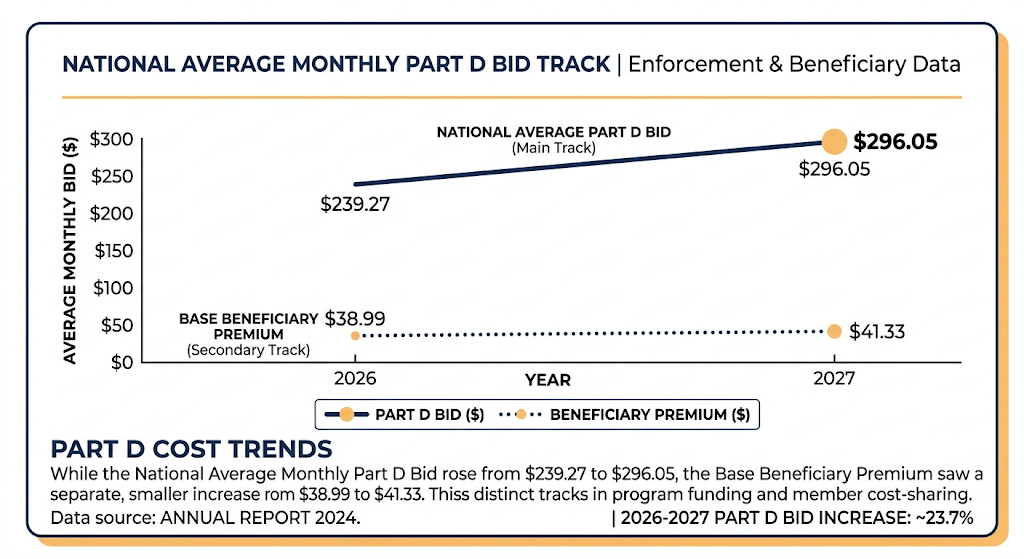 A wide gap separates the bid insurers file from what beneficiaries pay. Created via Gemini.
Dr. Mehmet Oz Administrator, Centers for Medicare & Medicaid Services
CMS Administrator Dr. Mehmet Oz framed the decision as ending a bailout for insurers rather than a cut to beneficiaries, writing that premiums would rise by less than $10 for most Medicare recipients, with some seeing lower costs. That estimate is only one part of the picture. A Trump administration official separately told the Wall Street Journal that just about a quarter of enrollees are projected to see flat or lower premiums, meaning the majority should expect some increase. The statutory 6% cap on the national base beneficiary premium remains in place through 2029, but that cap applies only to one narrow benchmark figure, not to what any individual actually pays once plan-level pricing, formularies, and regional variation are factored in.
For 25 million enrollees, the real number arrives in the Annual Notice of Change letter every Part D plan sends in late September, the document that finally converts CMS's national averages into an individual beneficiary's actual monthly premium. Ending a temporary subsidy can be a legitimate step toward normal market pricing, or it can quietly shift costs onto fixed-income retirees who have little room to absorb an increase, and which outcome occurs depends on decisions still being finalized inside CMS rather than on the framing used to announce the change.
Republicans and Democrats are converging on the same political instinct even as they disagree on nearly everything else: cutting taxes is popular, and neither party wants to be the one defending the current system. The One Big Beautiful Bill Act, signed into law in July 2025, made the 2017 tax cuts permanent for individuals and added new provisions exempting tips and overtime pay from taxation. Separately, and without a connection to that law, the IRS lost roughly 25,000 employees in 2025 through buyouts and firings, a 25% reduction in its workforce that has left the agency processing a more complex tax code with fewer people to enforce it.
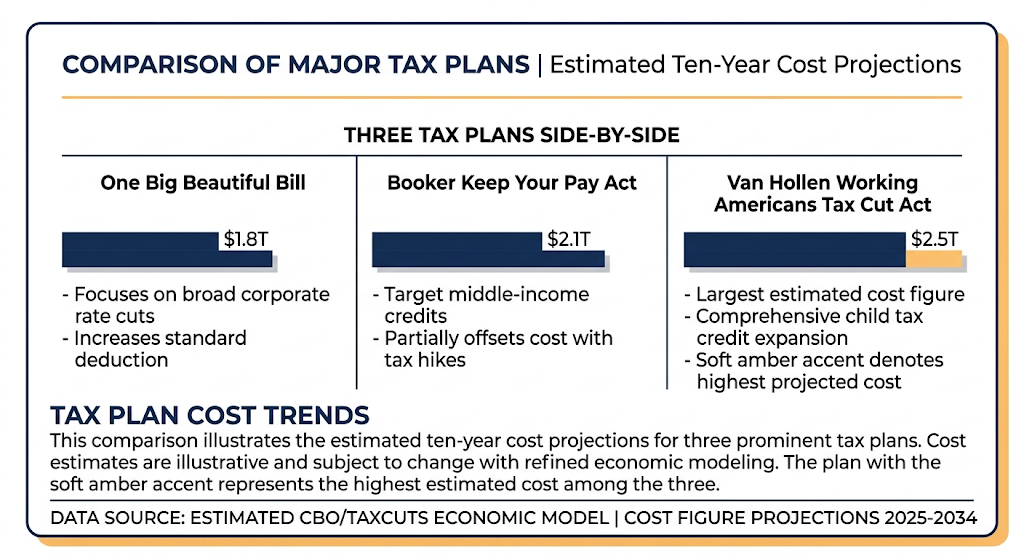
Three very different tax plans share one common price tag. Created via Gemini.
Senator Cory Booker, U.S. Senator, New Jersey
Senator Chris Van Hollen, U.S. Senator, Maryland
Democrats have introduced their own competing proposals rather than simply opposing Republican cuts. Senator Cory Booker's Keep Your Pay Act would more than double the standard deduction to $37,500 for single filers and $75,000 for married couples, at an estimated cost of $5 to $7 trillion over ten years depending on the model used. Senator Chris Van Hollen's Working Americans' Tax Cut Act takes a narrower approach, eliminating federal income tax for individuals earning under $46,000 and couples under $92,000, funded by a new surtax starting at 5% on income above $1 million.
Both parties are responding to genuine public frustration rather than inventing an issue. Gallup polling shows the share of Americans who consider their income taxes fair sits near its lowest point since the question was first asked in 1997, and YouGov survey data found roughly 60% of Americans at every income level believe they pay too much. That frustration is legitimate, but it collides with a federal deficit trending toward $2 trillion a year. A tax cut that wins votes today still has to be paid for eventually, whether through borrowing, reduced services, or a future tax increase, and neither party's current plan resolves that tension so much as defers it.
The 2017 Tax Cuts and Jobs Act cut the top marginal income tax rate from 39.6% to 37%, nearly doubled the standard deduction to $12,000 for individuals and $24,000 for married couples, and cut the corporate tax rate from 35% to 21% on a permanent basis from the start. Those individual provisions were originally scheduled to expire at the end of 2025, which set up the years-long "will Congress extend it" debate. The One Big Beautiful Bill Act resolved that question in July 2025 by making the individual rate cuts, the larger standard deduction, and the doubled child tax credit permanent, at a projected cost of $4.5 to $5.2 trillion in lost federal revenue over the following decade, according to the Tax Foundation and Joint Committee on Taxation.
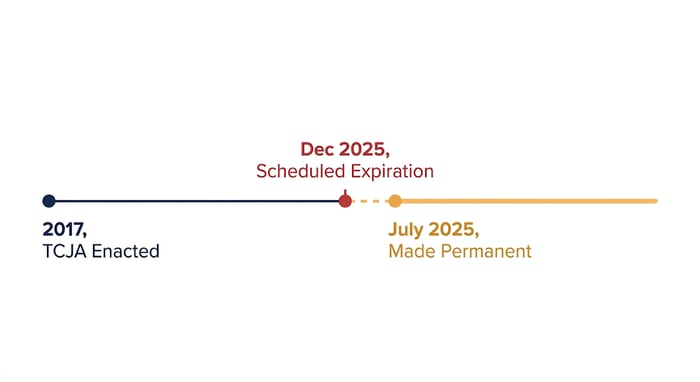
A scheduled expiration date was removed before it arrived. Created via Gemini.
How those permanent cuts are distributed remains genuinely disputed rather than settled. The Institute on Taxation and Economic Policy estimated the richest 5% of households receive close to half of the law's net tax cuts, while the Tax Policy Center found 60% of the benefit flows to households earning above $217,100. Republican lawmakers dispute that framing, pointing to Joint Committee on Taxation data showing the top 1% will pay a larger share of total federal income taxes after the law than before it, since their absolute tax bill still exceeds any cut they received. Both claims can be true at once: a household can receive the largest dollar cut while still paying a larger overall share of total taxes, which is exactly why this distributional debate keeps recurring every time tax policy changes.
The federal government deposits $1,000 into a low-cost stock market fund for every eligible child born between January 1, 2025, and December 31, 2028, through a program launched July 4, 2026. By July 6, more than 500,000 of those accounts had received their first federal deposit, and by mid-August enrollment had grown to roughly 7 million children signed up, according to Treasury Secretary Scott Bessent, though only about 1.4 million were confirmed eligible for the actual deposit at that point. The gap between sign-ups and funded deposits is itself a budget-process story, since it shows the program's rollout, not its funding, has been the bottleneck so far.
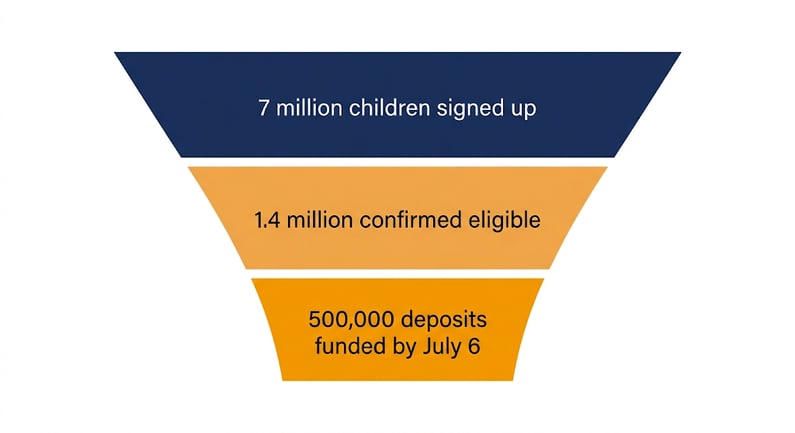
Enrollment has outpaced confirmed federal deposits. Created via Gemini.
Beyond the initial seed, the program allows layered contributions up to a combined $5,000 a year per child, with employer contributions capped at $2,500 and excluded from the employee's taxable income. More than 50 companies have committed to contributing, including a single $250 million pledge from Micron, and the Michael and Susan Dell Foundation committed $6.25 billion separately to fund $250 deposits for children in lower-income ZIP codes, a private philanthropic layer running alongside the federal one. When a beneficiary turns 18, the account converts to a standard IRA, and standard early-withdrawal rules, including a 10% penalty, apply from that point forward.
That contribution structure is exactly where the budget-process question sharpens. A flat $1,000 federal deposit is identical for every eligible child regardless of household income, but the $5,000 annual contribution ceiling rewards families who already have disposable income to invest, meaning the program's long-term wealth impact depends heavily on private contribution behavior the federal government does not control. Treasury frames this as leveling a playing field that previously required a trust fund; critics frame it as a universal seed layered under a fundamentally unequal contribution system. Both framings can be accurate at once, and which one dominates will depend on participation data by income level that is not yet available.
Fraud enforcement, subsidies, taxation, and new federal spending programs all draw from the same limited pool of federal dollars, and each decision trades one priority against another. Fraud enforcement returns more than it costs, yet the administration paired that enforcement narrative with pardons and reassigned prosecutors, raising real questions about whether the crackdown targets the money or the message. A temporary Medicare subsidy shielded 25 million beneficiaries from a sharp premium jump, and its expiration will show whether that redesign can hold without a federal buffer once real 2027 pricing lands this September. Two competing visions for tax reform, one banking on future growth to cover its cost and one funding itself through a millionaire surtax, now sit next to a tax law already made permanent without an offset, adding trillions to a deficit trending toward two trillion dollars a year. A new federal savings program deposits equal seed money into every eligible newborn's account, even as the private contribution structure layered on top of it all but guarantees unequal outcomes by the time those children turn eighteen.
None of these choices happen in isolation from the others. Every dollar spent shielding Medicare beneficiaries from a premium spike is a dollar not available for fraud enforcement or newborn seed accounts. Every dollar a tax cut removes from federal revenue is a dollar that has to be borrowed, cut from somewhere else, or eventually collected through a future tax increase. A government that pardons fraud while funding a crackdown, cuts taxes without agreement on how to pay for them, and launches new programs inside an already strained budget is a government making tradeoffs whether or not it names them as such. The next round of appropriations debates, continuing resolutions, and program reauthorizations will decide which of these tradeoffs the country actually accepts, and which ones simply get deferred to the next budget cycle.
-Sep-25-2026-10-55-02-0549-AM.jpg?width=300&name=image%20(1)-Sep-25-2026-10-55-02-0549-AM.jpg)
EnerVenue’s move from a planned Kentucky factory to China shows that advanced manufacturing depends...

Farmers are facing compounding financial, demographic, and infrastructure crises that traditional...
The U.S. has a financial superpower most Americans never think about. It may not last forever.