Government Taxation, Spending, and Debt
All 50 states, Washington, D.C., and Puerto Rico have applied to a new Medicaid drug-pricing model, but projected government savings will not automatically become guaranteed savings for every patient.
What to Know
- All 50 states, Washington, D.C., and Puerto Rico applied to participate in CMS’s GENEROUS Model.
- As of September 18, 2026, 40 states and Puerto Rico had signed participation agreements.
- CMS estimates the model could save taxpayers $64.3 billion over 10 years.
- States would invoice participating drug manufacturers for supplemental rebates that align selected Medicaid drug prices with international reference prices.
- Savings for Medicaid programs do not automatically establish lower copays, broader coverage, or improved access for each patient.
CMS announced that every state, Washington, D.C., and Puerto Rico had applied for the GENErating cost Reductions fOr U.S. Medicaid, or GENEROUS, Model. Officials said 40 states and Puerto Rico had already signed agreements as of September 18, 2026, while other applicants had until September 30 to finalize participation.
CMS launches GENEROUS Model to lower Medicaid drug costs via cms.gov
https://www.cms.gov/newsroom/press-releases/cms-announces-participants-landmark-medicaid-drug-payment-model-bring-down-drug-costs-mostMedicaid drug pricing is a federal budget issue with direct consequences for state budgets and patient care. CMS estimates that GENEROUS could save $64.3 billion in taxpayer dollars over 10 years. That estimate describes potential savings for government programs, however, not a guaranteed reduction in any individual’s pharmacy bill. Understanding how rebates flow through Medicaid explains what the model can change and what it cannot.
How GENEROUS Changes Drug Pricing
CMS launched GENEROUS in January 2026 as a five-year voluntary model for participating states and drug manufacturers. For drugs included in the model, manufacturers would offer Medicaid prices based on what selected other countries pay.
Medicaid already uses the Medicaid Drug Rebate Program, under which manufacturers provide rebates in exchange for Medicaid coverage of their outpatient drugs. States can also negotiate supplemental rebates beyond the statutory rebate.
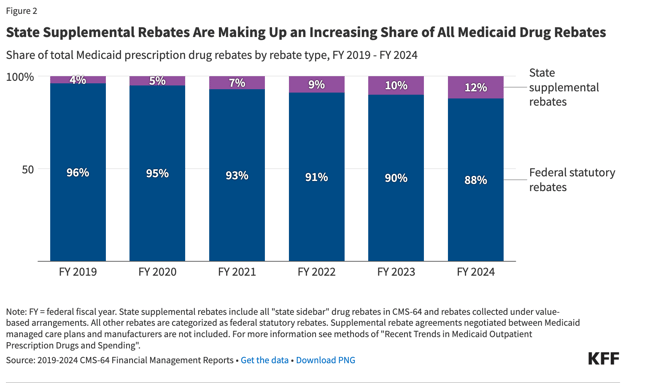
Supplemental rebates’ growing role in Medicaid. KFF.
GENEROUS adds a new route to lower net prices. A state would pay for a covered drug, calculate the applicable supplemental rebate, and invoice the participating manufacturer quarterly. CMS would monitor the pricing calculation, while the federal government would share in the rebate through a reduction in its share of Medicaid payments.
Covered drugs will not include every prescription. CMS says the model applies to single-source and innovator multiple-source outpatient drugs from manufacturers that choose to participate. States also decide which, if any, eligible drugs they want to include. That flexibility makes the program less of a uniform national price rule and more of a series of state and manufacturer agreements.
Understanding that structure is important because a lower government net price does not necessarily change the price a beneficiary sees at the pharmacy counter.
Projected Savings Are Not Guaranteed Patient Savings
CMS estimates $64.3 billion in taxpayer savings over 10 years, but that figure is a projection. Actual savings will depend on participating manufacturers, selected drugs, negotiated coverage terms, utilization, rebate accuracy, and state implementation.
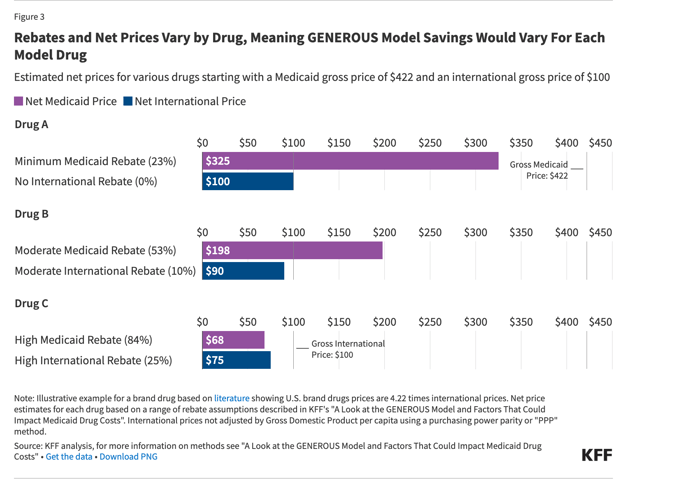
Drug rebates determine potential GENEROUS savings. KFF.
Medicaid beneficiaries may already face limited cost sharing, depending on their state and coverage category. As a result, a lower rebate-based net price may first affect state and federal spending rather than a patient’s direct payment. State Medicaid agencies could use savings to support other services, preserve coverage, or address budget pressure, but CMS has not promised a specific use for any savings.
Access also remains a separate issue from price. CMS says manufacturers and the agency will negotiate standardized coverage criteria for drugs in the model. Standardized criteria could reduce the burden of separate negotiations across states and may improve access to selected medicines. Participation alone does not guarantee that every drug will be covered, that every patient will meet coverage criteria, or that a prescription will face no prior-authorization requirement.
Those distinctions turn the next question toward implementation: which manufacturers and states will participate, and what terms will they accept?
What States and Manufacturers Must Decide
Participation is voluntary for both states and manufacturers. CMS says states can compare the proposed international price with other available drugs, existing rebates, and the length of current supplemental-rebate agreements before selecting drugs for the model.
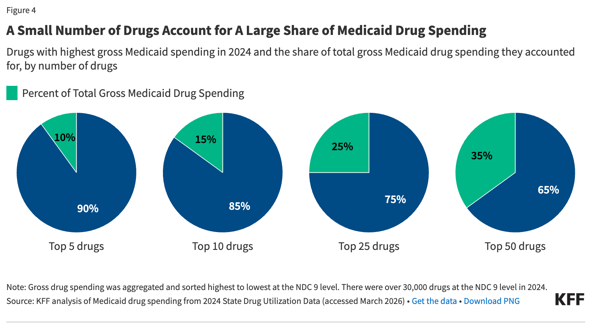
A few drugs drive Medicaid spending. KFF.
Manufacturers must decide whether lower net prices and standardized coverage criteria provide enough value to join. Companies participating in the model would need an active federal Medicaid rebate agreement and would negotiate terms with CMS before signing agreements with interested states.
State Medicaid agencies face operational choices as well. Participating states must secure authority for supplemental-rebate agreements, administer quarterly invoicing, and align coverage policies with Medicaid managed-care organizations where applicable. Administrative costs and implementation capacity will therefore matter alongside the headline rebate amount.
CMS reports that net Medicaid prescription-drug spending reached $60 billion in 2024, up $10 billion from 2022. Rising spending gives states a reason to test new purchasing approaches, but reliable results will require public reporting on participating drugs, net savings, coverage criteria, and patient-access outcomes.
Wrap Up
GENEROUS gives states a new voluntary tool for seeking international reference prices on selected Medicaid drugs. Its design relies on supplemental rebates, manufacturer participation, and state-level choices rather than an automatic nationwide price cut.
Savings may help federal and state budgets, but no current evidence guarantees a specific patient saving or access improvement. Results will depend on the drugs included, the manufacturers that participate, the coverage terms CMS negotiates, and how states use any savings that materialize.