
Government Taxation, Spending, and Debt
Pass-through businesses support entrepreneurship and investment, but differences in how business income is classified can produce sharply different tax outcomes
What to Know
- Pass-through businesses generally send profits and losses to their owners’ individual tax returns instead of paying the corporate income tax.
- Pass-through entities generated 54.2% of U.S. business income by 2011, up from 20.7% in 1980.
- Research found that approximately 70% of partnership and S-corporation income accrued to the top 1% of earners.
- Treasury estimated that a proposed expansion of the Net Investment Income Tax would raise $393.2 billion from 2025 through 2034.
- GAO found that the IRS audited only 54 of 20,052 large partnerships in tax year 2019.
Pass-through businesses range from small family firms to investment partnerships holding billions of dollars in assets. Partnerships and S corporations generally do not pay the corporate income tax. Instead, their profits and losses pass through to owners, who report applicable amounts on their individual tax returns.
Business structure alone does not make income tax-free. Still, differences among corporate taxes, individual taxes, payroll taxes, and the Net Investment Income Tax can produce significantly different results for owners earning similar amounts. Those differences have become more important as pass-through income has expanded and become increasingly concentrated among high-income households.
How Pass-Through Taxation Works
Most traditional corporations operate as C corporations. A C corporation pays corporate income tax on its taxable profits, and shareholders may owe another tax when they receive dividends or sell appreciated shares.
Partnerships and S corporations follow a different model. Applicable income generally passes to owners and appears on their individual returns, even when the business does not distribute all its cash. Sole proprietorships also report business income through their owners’ returns.
|
Business structure |
Entity-level income tax |
How owners are generally taxed |
Payroll-tax consideration |
|
C corporation |
Yes |
Dividends and capital gains may be taxed separately |
Employee wages face payroll taxes |
|
S corporation |
Generally no |
Owners report allocated business income |
Owner-employees owe payroll taxes on reasonable compensation |
|
Partnership |
Generally no |
Partners report their distributive shares |
Treatment depends on partner status and participation |
|
Sole proprietorship |
No separate entity tax |
Owner reports net business income |
Net earnings generally face self-employment tax |
Table: Business structures create different tax and payroll obligations.
Avoiding a separate corporate tax serves a legitimate policy purpose. Small and closely held companies can operate without facing one tax at the business level and another when owners receive earnings. Problems arise when legal form or payment classification changes the tax imposed on economically similar work.
That distinction becomes especially important when compensation can be divided between wages and business distributions.
Why Payroll Taxes Create a Planning Opportunity
S-corporation owner-employees must pay themselves “reasonable compensation” for services they perform. Those wages face Social Security and Medicare payroll taxes, just like wages paid to other employees. Remaining profits can generally reach shareholders as distributions that are not subject to FICA or self-employment taxes.

Treasury explains payroll-tax treatment for S-corporation owners. via Treasury FY2025 Greenbook
Owners therefore have an incentive to classify more earnings as distributions and less as salary. Tax law prohibits an artificially low salary, but determining reasonable compensation requires the IRS to examine duties, hours, experience, industry pay, and other facts.
Commentators commonly call this planning opportunity the “Gingrich-Edwards loophole,” after former House Speaker Newt Gingrich and former Senator John Edwards faced scrutiny over their use of S corporations. Political personalities, however, are less important than the underlying rule: two people performing economically similar work can face different payroll taxes depending on how their income is structured.
The Treasury Department’s fiscal year 2025 revenue proposals identified another inconsistency. Certain active-business distributions to S-corporation shareholders and limited partners can escape both the 3.8% Net Investment Income Tax and the equivalent combination of Medicare employment taxes.
Understanding that classification issue helps explain why the growth of pass-through businesses affects more than small-business administration.
How Four Decades Changed the Distribution
Tax changes during the 1980s altered the incentives governing business organization. Reductions in individual income-tax rates made pass-through status more attractive for many owners, while later legal changes made partnerships easier to use for larger and more complicated enterprises.
Research published by the National Bureau of Economic Research found that pass-through entities accounted for 20.7% of U.S. business income in 1980. Their share reached 54.2% by 2011, meaning pass-through firms generated more than half of business income.
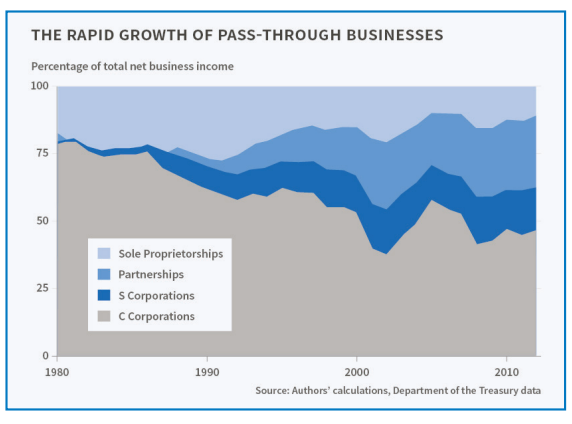
Pass-through businesses expanded sharply after 1980. via NBER Digest PDF.
Distribution matters as much as growth. Researchers found that approximately 70% of partnership and S-corporation income accrued to the top 1% of earners. Pass-through income also accounted for a substantial share of the increase in top-income concentration after 1980.
None of those findings means that every partnership represents tax avoidance. Many pass-through businesses conduct ordinary commercial activity, employ workers, assume financial risk, and pay substantial taxes. Concentration does mean that changes to pass-through taxation can have large distributional consequences even when policymakers describe them as small-business policy.
Rising complexity also creates a practical enforcement problem for the agency responsible for applying those distinctions.
Why IRS Enforcement Struggles With Complexity
Large partnerships can contain multiple ownership tiers, affiliated entities, foreign investors, trusts, and other partnerships. Income or deductions may move through several entities before reaching the final taxpayer.
A Government Accountability Office review counted 20,052 partnerships with at least 100 partners and $100 million in assets in tax year 2019. IRS auditors examined only 54, producing an audit rate of approximately 0.3%.
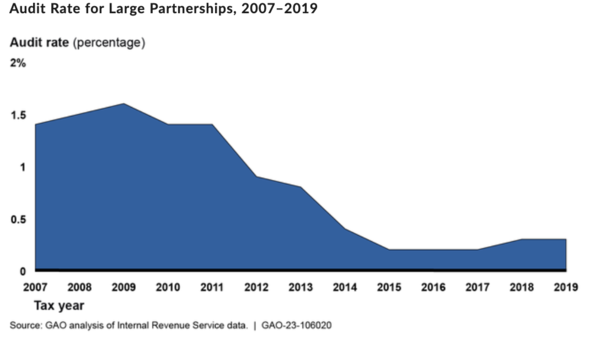
Large-partnership audit rates declined as their numbers grew. From GAO report page.
Limited enforcement does not prove that every unaudited return contains unpaid tax. GAO also found that more than 80% of completed large-partnership audits produced no change on average from tax years 2010 through 2018. That result may reflect compliant returns, weak audit selection, insufficient expertise, or difficulty tracing income through complicated structures.
Reasonable-compensation cases create a related challenge. Examiners must establish the value of an owner’s labor before determining whether too much income was classified as a distribution. Such disputes demand time, industry knowledge, and valuation evidence.
Enforcement can address misclassification, but broader questions about consistent tax treatment ultimately require legislative decisions.
What Reform Would Change
Treasury previously proposed expanding the 3.8% Net Investment Income Tax so high-income owners’ active pass-through earnings would generally face either that tax or employment taxes. Coverage would have phased in between $400,000 and $500,000 of adjusted gross income.
Treasury estimated that the proposal would raise $393.2 billion from 2025 through 2034. That estimate was a forecast for a proposed policy, not an accounting of taxes already lost or a guarantee of future collections.
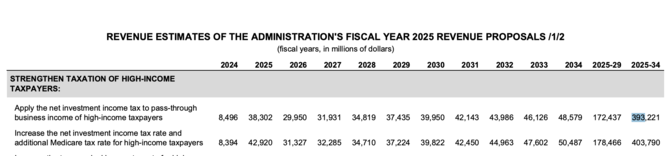
Treasury projected $393.2 billion from the proposed change.via Treasury FY2025 Greenbook.
Supporters argue that reform would reduce incentives to classify labor income as business distributions and treat similar earnings more consistently. Critics warn that broader taxes could reduce investment, complicate business succession, or affect owners whose wealth is tied to companies rather than readily available cash.
Policy design can narrow those disagreements. Income thresholds can concentrate changes on high earners, while clear participation and compensation standards can reduce uncertainty for ordinary businesses. Stronger reporting and better audit selection can also target noncompliance without treating every pass-through owner as a suspected tax avoider.
Any durable solution must balance entrepreneurship with neutrality, administrability, and confidence that comparable income faces comparable rules.
Wrap Up
Pass-through businesses remain an essential part of American capitalism. Their tax structure allows companies to avoid a separate corporate-level tax while requiring owners to report applicable income individually.
Concern arises when economically similar earnings receive different payroll or investment-income tax treatment because owners select different legal forms or payment labels. Rapid pass-through growth, concentrated ownership, and complicated partnership structures have magnified that concern.
Policymakers do not have to choose between supporting entrepreneurship and enforcing the tax code. Clearer classification rules, targeted thresholds, reliable reporting, and capable enforcement can protect legitimate businesses while reducing opportunities available mainly to taxpayers with sophisticated planning resources.