Financial Literacy
The technology behind artificial intelligence and electrification depends on materials that the United States often cannot mine, process, or replace quickly.
What to Know
- Project Vault is a $12 billion civilian critical minerals stockpile announced in 2026.
- A $10 billion Export-Import Bank loan supports the public-private reserve.
- The United States imported 80% of the rare earth elements it used in 2024.
- Project Vault protects manufacturers from disruptions but does not solve domestic processing shortages.
- Congress is considering bills covering mineral processing, mapping, education, permitting, and supply resilience.
Artificial intelligence, electric vehicles, smartphones, batteries, solar panels, and power grids depend on critical minerals. Lithium stores energy, graphite supports battery anodes, cobalt strengthens performance, manganese serves batteries and steel, and rare earth elements power magnets, motors, displays, and electronics.
The United States depends on foreign mines and processors for many of these materials. Project Vault creates a civilian reserve to protect manufacturers during interruptions. Its household value depends on whether it becomes a bridge toward stronger domestic capacity or merely stores imported materials.
What Critical Minerals Do
The Department of Energy defines critical materials through their importance to energy technologies and exposure to disruption. Its applications connect lithium, cobalt, graphite, manganese, and nickel to batteries. Gallium and germanium support semiconductors, while rare earth elements support magnets, motors, displays, and electronics.
These materials sit inside familiar products. A phone requires battery minerals, display materials, copper, and semiconductor inputs. Electric vehicles need larger batteries and powerful magnets. Solar equipment, transmission systems, appliances, and data centers require additional metals.
Consumers rarely buy raw minerals, but they pay for shortages through finished products. Disruptions can delay production, reduce inventory, and raise manufacturing costs. That connection explains why foreign dependence has become an economic concern.
Foreign Dependence Creates Risk
Everyday Technology Depends On Complex Mineral Supply Chains. Created via Gemini.
The U.S. Geological Survey reported that the United States imported 80% of the rare earth elements it used in 2024. China dominates multiple critical mineral supply chains and has used export controls, making dependence an economic and national security risk.
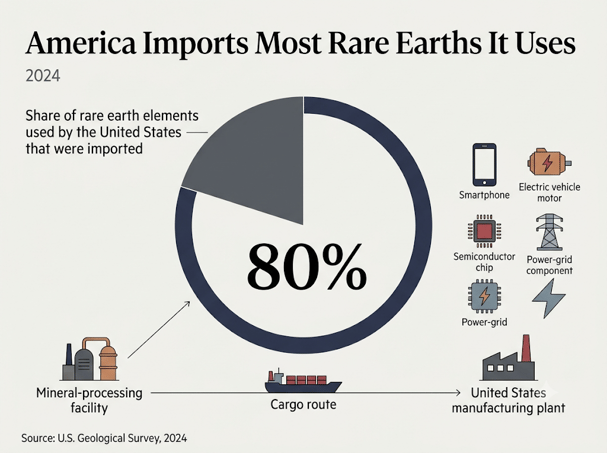
Everyday Technology Depends On Complex Mineral Supply Chains. Created via Gemini.
Mining is only one bottleneck. Minerals must also be separated, refined, and converted into usable materials. A domestic mine provides limited protection when its output still travels overseas for processing.
Supply concentration gives foreign governments and companies leverage over availability, delivery, and prices. That vulnerability can raise costs for vehicles, electronics, energy equipment, and grid projects. Project Vault attempts to reduce the immediate shock.
What Project Vault Actually Does
The Bipartisan Policy Center describes Project Vault as a $12 billion public-private civilian stockpile backed by a $10 billion Export-Import Bank loan. Participating manufacturers help choose which minerals are purchased and their suppliers.
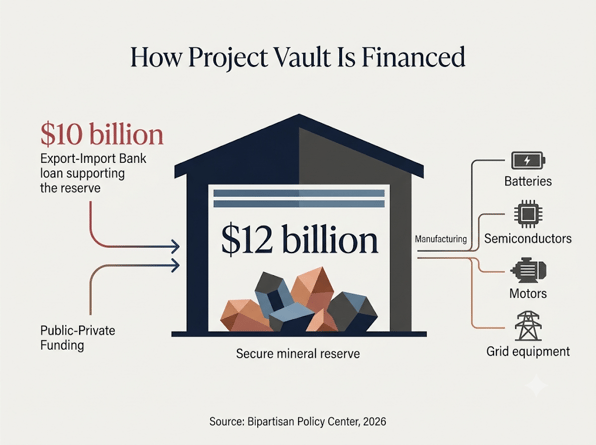
Project Vault Builds A Buffer Against Supply Disruptions. Created via Gemini.
The reserve could provide emergency protection or help stabilize material prices. The Bipartisan Policy Center warns that price stabilization requires commodity expertise, strong oversight, and clear operating rules. Congress could also set sourcing rules, processing requirements, transparency standards, and a sunset date so the reserve remains a temporary bridge rather than becoming a permanent substitute for domestic investment capacity.
The structure has weaknesses. It lacks firm sourcing mandates, does not guarantee domestic processing, and has limited ability to support American mines and processors. Project Vault may cushion disruptions, but domestic capacity requires broader policy.
Congress Is Working On The Rest
The Northeast-Midwest Institute tracks proposals across the supply chain. The Critical Materials Future Act would support domestic processing. The Mining Schools Act would fund mining education, while other bills address mapping, manufacturing, trade partnerships, and government coordination.
Permitting proposals are also advancing. The tracker includes the Streamlining Critical Mineral Permitting Act and measures placing some mineral projects within federal review frameworks. Supporters argue that clearer timelines can reduce uncertainty and attract investment.
Faster approval alone cannot create a resilient industry. Projects still need financing, workers, community engagement, safeguards, processing facilities, and buyers. Policy must coordinate those pieces without treating one reform as a complete solution.
What This Means For Household Costs
Critical mineral security affects products families use daily. Reliable supplies can reduce factory delays, shortages, and price spikes for vehicles, electronics, batteries, solar systems, and grid equipment.
Domestic production also involves tradeoffs. Mines and processing plants require capital, infrastructure, water, energy, and environmental review. Taxpayers may support loans, incentives, research, mapping, workforce programs, or strategic purchases before benefits reach consumers.
The affordability question is whether public investment builds lasting capacity. A stockpile can buy time during disruption, but it cannot replace mining, processing, recycling, and manufacturing. Household benefits depend on the entire chain becoming more competitive and reliable.
Wrap Up
Project Vault recognizes that mineral dependence can interrupt technologies supporting economic growth. Its $12 billion structure may help manufacturers manage short-term shocks, but it cannot independently create American mines, processing plants, skilled workers, or stable markets.
The larger race will be decided by permitting, financing, processing, recycling, workforce development, allied partnerships, and oversight. For consumers, this is more than defense policy. Critical mineral supply chains will influence what advanced products cost and whether they remain available when global trade is disrupted.