Financial Literacy
A universal investment seed can expand ownership, yet unequal contributions may compound the wealth divide over time.
What to Know
- More than 500,000 eligible children had received federal deposits of $1,000 by July 6, 2026.
- Eligible newborns receive the public seed in broad, low-cost stock-market funds rather than guaranteed savings.
- Families, charities, governments, and employers may contribute, with qualifying employer contributions capped at $2,500 per employee annually.
- Beneficiaries gain control in the year they turn 18, when standard individual retirement account rules generally begin to apply.
- Equal federal deposits may still produce unequal adult balances because families have different capacities to contribute and remain invested.
The federal government gives each eligible newborn a $1,000 investment deposit and places it in a low-cost stock-market fund. More than 500,000 children had received the first deposits by July 6, 2026. The policy gives families an immediate key to equity ownership, but it does not guarantee savings or future returns.
Every qualifying child begins with the same public seed, yet household finances determine how strongly that seed can compound. Families with disposable income can add money regularly and leave it invested, while families facing housing, food, medical, or childcare costs may contribute little or nothing. The experiment will test whether equal access to the market can expand opportunity when families have unequal capacity to build on it.
How Trump Accounts Work
Reuters reported that the accounts cover qualifying U.S. citizens born from 2025 through 2028. Treasury deposits $1,000 into a low-cost index fund designed for long-term growth. Account holders gain control during the calendar year they turn 18 and may withdraw funds or continue investing.
The U.S. Treasury Department says families can view balances, connect bank accounts, establish recurring contributions, and monitor investment performance through the app. Employers can contribute up to $2,500 per employee each year to the employee’s account or a dependent’s account through a qualifying contribution program, and that amount is excluded from the employee’s taxable income. More than 50 companies had committed to employee contributions at launch.
When the beneficiary reaches 18, most special restrictions end and traditional individual retirement account rules generally apply. Investment growth remains tax-deferred until withdrawal, while taxable distributions may face income tax and a 10% early-distribution penalty unless an exception applies. The app’s 15 education modules explain saving, investing, compound growth, diversification, and capital markets before families make those decisions.
That structure differs sharply from traditional social safety nets. Trump Accounts do not provide immediate income support or guaranteed protection against current food, housing, or medical costs. They create a long-term market asset whose final value depends on contributions, investment performance, taxes, and withdrawal timing.
Testing the Wealth Gap
The public deposit creates a common opening balance for eligible newborns. That matters for children whose families might otherwise open no investment account. Early ownership also gives compounding more time than saving that begins in adulthood.
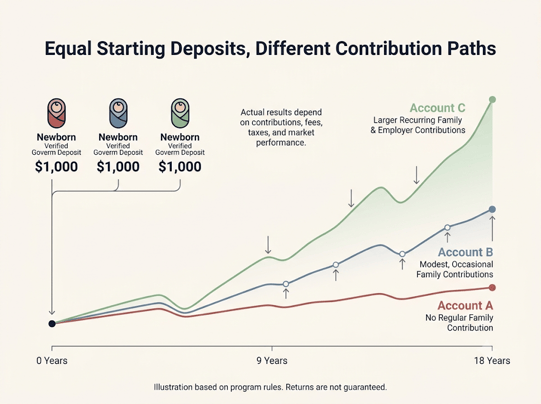
Equal Seeds Can Grow Into Unequal Adult Balances. Created via Gemini.
The equality ends when private contributions begin. Higher-income families can contribute regularly, accept volatility, and leave the account untouched. Families facing rent, food, medical, or childcare pressure may have little available cash.
Reuters reported that critics question whether households with limited disposable income can benefit fully. Supporters answer that the initial $1,000 removes the barrier of starting with nothing. Both claims can be true, shifting the debate from access toward eventual balances.
Measuring the Taxpayer Cost
At the first reported milestone, more than 500,000 deposits represented at least $500 million in federal seed funding. That calculation covers funded accounts at that point, not every child who may qualify. As participation grows, the fiscal commitment grows.
The cost must be compared with the public value created. Wider stock ownership could strengthen saving habits, financial knowledge, and household assets. The return will be weaker if subsidies mainly amplify investments affluent families would have made anyway.
Evaluation should examine participation by income, recurring contributions, fees, withdrawals, and final balances. Enrollment totals alone cannot show whether the policy broadens wealth. Those measurements lead directly to the risk carried inside every account.
Understanding Investment Risk
Trump Accounts are investments, not insured savings. Broad index funds spread money across many companies, reducing dependence on one stock without eliminating losses. A market decline can reduce an account’s value when a family needs money.
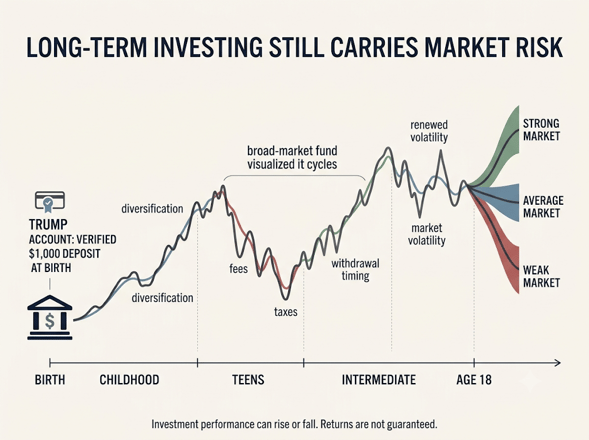
Market Growth Can Reward Time Without Guaranteeing Returns. Created via Gemini.
Time can help investors recover, but recovery is never guaranteed on a particular schedule. A child reaching 18 during a weak market may delay a goal or sell at a lower value. Taxes upon withdrawal can further reduce available funds.
Financial education is therefore part of the policy. Families need to understand volatility, diversification, fees, taxes, and withdrawal timing before treating projected growth as promised money. The account creates an opportunity, while the household carries the outcome.
Ownership Policy or Redistribution
The fiscal cost and market risk lead to a broader policy question. The government finances the opening deposit, but families carry the investment outcome after the money enters private capital markets. Supporters see market-based wealth building, while critics see redistribution because taxpayers fund the initial asset.
The strongest test is not the political label attached to the program. Government can create access to equity ownership, but it cannot equalize disposable income, contribution capacity, or market returns. A universal $1,000 seed may therefore broaden participation while still producing sharply unequal balances.
The program also arrived as affordability remained a major concern ahead of the 2026 midterm elections. A long-term account does not lower current grocery, housing, childcare, medical, or insurance bills. Its economic value will depend on whether future ownership becomes meaningful for families facing immediate financial pressure.
Wrap Up
Trump Accounts give eligible children an investment stake from birth and introduce families to compounding, diversification, and market ownership. The $1,000 deposit can remove the barrier of starting with nothing. It cannot replace immediate cost-of-living relief or traditional programs addressing current household needs.
Enrollment numbers will show how widely the program reaches, but they will not prove that it builds lasting wealth. Policymakers must examine contribution patterns, employer support, fees, taxes, withdrawals, and final balances across income groups. The central question is whether lower-income children remain invested and accumulate meaningful assets by age 18.
Universal seed capital combines taxpayer support with private-market growth. That structure may widen ownership while still producing unequal outcomes because families have different resources to contribute. The policy will succeed only if access becomes durable wealth for children who would otherwise enter adulthood without invested assets.