Mortgage
Rising property insurance costs are quietly pushing millions of U.S. households to the brink of financial insolvency.
What to Know
- Annual U.S. home insurance premiums are projected to approach $3,100 in 2026, the fifth straight year of increases.
- Nearly 50 percent of surveyed homeowners would struggle to pay their mortgages if rates continue to rise.
- A staggering 74 percent of buyers state that property insurance premiums heavily influence their housing budgets.
- U.S. home insurance rates climbed about 47% from 2020 to 2025, outpacing overall inflation several times over.
- High-risk states like Florida now face average annual premiums above $7,000, more than double the U.S. average.
For decades, buying a home followed a predictable formula of mortgage principal, interest, and taxes. Today, property insurance has transformed into a volatile and major financial burden. Driven by climate risks and skyrocketing rebuilding costs, surging insurance premiums have become a primary driver of housing unaffordability that actively undermines homeownership.
The urgency of this crisis is critical in 2026 as premiums climb for a 5th consecutive year, with the national average projected near $3,100 for a standard policy. Because lenders mandate property insurance to protect their collateral, these rising rates act as an involuntary increase in monthly housing payments, pushing household budgets to a dangerous tipping point.
The Direct Link Between Premiums and Mortgage Defaults
The relationship between rising insurance premiums and mortgage stability is direct. Unlike discretionary expenses, property insurance is a strict legal requirement for any mortgaged home. When premiums rise, lenders adjust escrow accounts, forcing monthly housing costs up by hundreds of dollars even for borrowers with fixed-rate mortgages. This sudden inflation of housing costs bypasses the protection of fixed interest rates, catching many families completely off guard.
Indeed, 74 percent of buyers report that insurance premiums now heavily influence housing budgets. This financial strain is manifesting in consumer behavior, with nearly half of surveyed homeowners, approximately 47 percent, stating they would struggle to pay their mortgages if premium rates continue to rise. This highlights a fragile market where modest rate hikes could trigger widespread delinquencies and foreclosure filings.
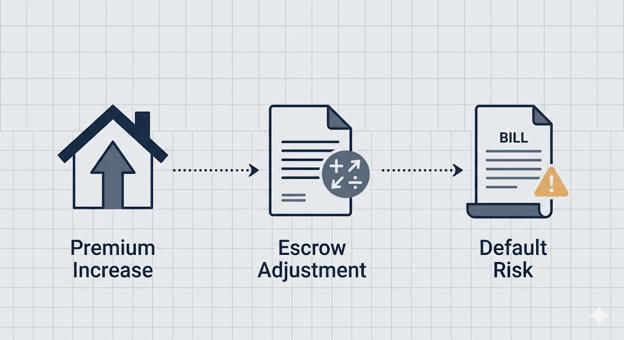
Escrow hikes drive mortgage defaults. Created via Gemini.
Homeowners who cannot afford these increased payments face a 2-edged sword. They must either fall behind on mortgage payments or risk policy cancellation. A canceled policy leads to expensive lender force-placed insurance, which accelerates the downward financial spiral and increases default risk.
Extreme Weather and Rebuilding Costs Drive the Surge
Insurers are grappling with a dramatic rise in both major natural disasters and secondary perils, such as severe convective storms, localized tornadoes, and heavy hail. These frequent, smaller-scale events have caused tens of billions of dollars in cumulative annual losses, forcing insurers to purchase expensive reinsurance and pass those costs directly to consumers.
Rising home insurance costs have shifted from a local headache in coastal states to a structural threat to homeownership nationwide, as climate risk and rebuilding costs drive premiums higher across the map.
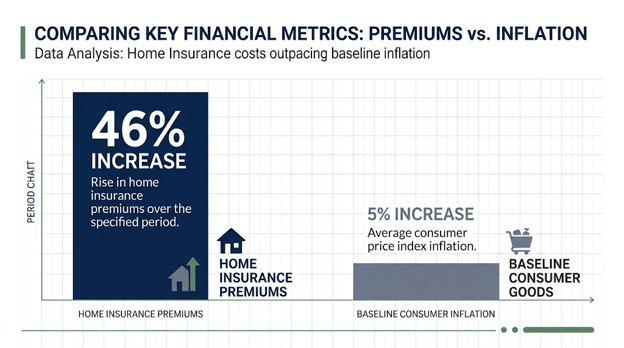
Insurance inflation outpaces consumer prices. Created via Gemini.
Compounding this is the cost of rebuilding. The price of construction materials and specialized labor has risen dramatically over the past 5 years. Consequently, even without physical damage, a home's replacement value and premium must rise. This helps explain why U.S. home insurance premiums jumped nearly 47% between 2020 and 2025 which is 3 times overall inflation, leaving property owners with fewer, more expensive coverage options.
Policy Solutions and Market Interventions
Resolving this crisis will require a comprehensive approach from state and federal policymakers. Currently, the regulatory landscape is fragmented, leaving individual states to manage insurance solvency on their own. Federal frameworks, such as the Dodd-Frank Wall Street Reform and Consumer Protection Act, were designed to monitor systemic financial risks, yet they offer few tools to address insurance-driven mortgage defaults on the ground.
At the federal level, lawmakers must look at historical precedents. Just as the National Flood Insurance Act of 1968 established a federal backstop for flood risks, there may soon be a need for broader federal reinsurance programs to stabilize the private market. Such measures could prevent catastrophic insurer insolvencies while ensuring that homeowners can access essential coverage without being priced out.
At the same time, state regulators must balance carrier solvency with consumer protection. Allowing insurance companies to raise rates unchecked keeps them in the market, but pushes families toward default. Policymakers must incentivize home mitigation, encouraging owners to fortify properties against severe weather in exchange for guaranteed rate reductions.
Wrap Up
The surging cost of home insurance is no longer a marginal concern. It is a central threat to the financial security of everyday Americans and the stability of the broader housing market. When nearly 50 percent of all homeowners warn that further rate hikes will jeopardize their ability to pay their mortgages, the warning signs of systemic stress are clear.
Moving forward, prospective buyers must factor property insurance into their long-term budgets rather than treating it as an afterthought. Simultaneously, policymakers must act with urgency to reform insurance markets and invest in climate-resilient infrastructure. If left unaddressed, the next housing crisis will be caused by the reality that the American home has become too expensive to protect.
The days of treating home insurance as a set-and-forget escrow expense are over. Premium increases can quietly disrupt a fixed-rate mortgage budget, making it essential for buyers to shop insurance before closing, explore mitigation discounts and fortification programs, and review policies annually rather than relying on automatic renewals.