AI Infrastructure
Unlocking 23 Gigawatts Without Building an Entirely New Power Grid
DOE’s SPARK selections aim to move more electricity through existing infrastructure as data...
Global rivals are racing to build energy capacity, industrial output, and technological infrastructure while America's own fiscal foundation and workforce pipeline are under strain, testing whether the country can still out build and out compete.
Competing on the world stage used to mean out producing rivals on factory floors and shipping docks. Increasingly it means out building energy capacity, semiconductor supply chains, and artificial intelligence infrastructure fast enough to matter before a strategic window closes. China's economy is shifting under its own pressures, its energy import dependence is shrinking as electric vehicles displace oil demand, while its property collapse has reshaped industrial output in ways that ripple through global markets. Meanwhile, the institutions built to manage global economic crises, the IMF, the G-7, coordinated central bank action, are operating with less fiscal room than at any point in decades.
America's own position depends on factors that rarely make headlines together. A permitting system that takes over a decade to approve a single transmission line slows the buildout of the energy capacity AI infrastructure requires. A federal deficit trending toward $2 trillion a year limits how much the country can invest in the workforce, manufacturing base, and industrial capacity that competitiveness actually requires. A trade policy built on legally fragile tariff revenue can turn into a budget liability overnight. None of these are separate contests. They are different fronts in the same competition over whether America can still build, produce, and hold strategic ground.
China's crude oil imports fell 1.9% in 2024, the first decline outside a pandemic year, a signal that the world's largest energy importer is undergoing structural change rather than a temporary slowdown. Apparent diesel consumption, closely tied to construction and industrial activity, fell from 4.7 million barrels per day in April 2023 to 4.0 million barrels per day in April 2025, according to Rhodium Group research, the steepest sustained decline the country has recorded in years. Rhodium Group attributes the drop to three converging forces: a real estate slowdown that reduced construction diesel demand, expanding LNG-fueled trucking, and a passenger and commercial vehicle fleet electrifying fast enough to erase over 1 million barrels per day in implied oil demand.
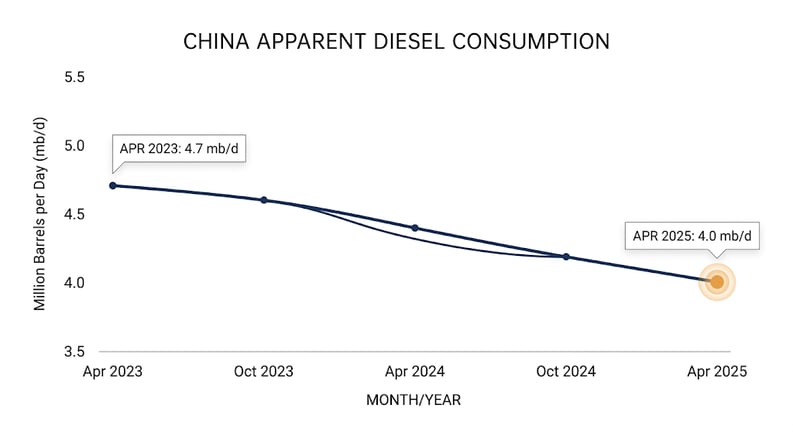
Diesel demand traces China's industrial slowdown since 2023. Created via Gemini.
This shift changes global oil market leverage, not America's separate bottleneck in energy infrastructure. A structurally weaker Chinese demand baseline shifts pricing power away from OPEC, and the United States, now the largest crude producer in history, benefits from that repricing at the pump and in energy markets broadly. That advantage does not, on its own, solve the permitting delays and grid capacity limits that determine how fast America can build the energy infrastructure AI and manufacturing actually require. Those are separate fronts in the same competition, one measured in global barrels, the other in years spent waiting on a transmission line permit.
The International Monetary Fund's April 2026 World Economic Outlook downgraded global growth to 3.1% for the year, down from 3.4% in 2025 and the 3.3% the fund had projected before war broke out between the United States, Israel, and Iran in February. That downgrade traces directly to the closure of the Strait of Hormuz, a waterway that historically carried roughly one-fifth of the world's oil and liquefied natural gas trade. The Atlantic Council estimated the closure removed 13% of global oil supply, a disruption the group compared in scale to the 1973 oil embargo, except this one is a physical blockage rather than a political one that can be reversed by a single agreement.
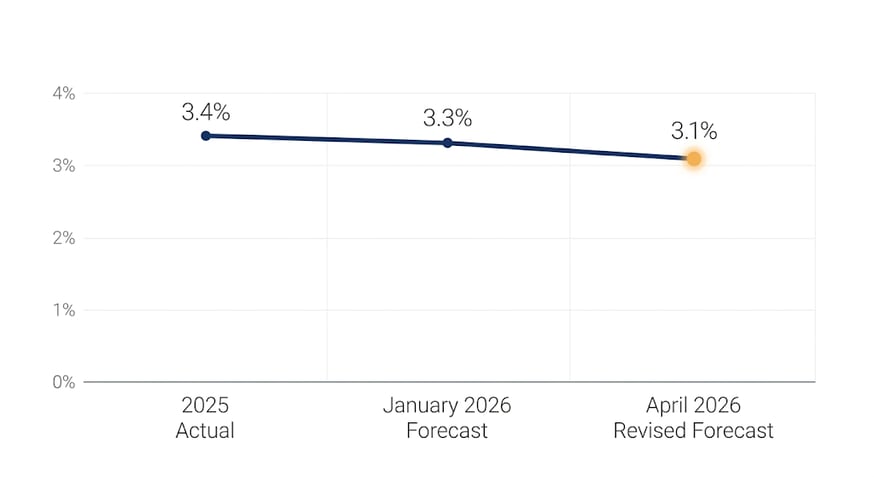
Global growth forecasts fell as the energy shock spread. Created via Gemini.
The strain reaches far beyond energy markets. The World Food Programme has warned the Hormuz disruption could push as many as 45 million additional people into acute food insecurity if fertilizer and grain shipping routes are not restored, since Gulf nations supply a large share of the nitrogen fertilizer that developing-world farmers depend on. Meanwhile, the institutions built to absorb shocks like this one have less room to maneuver than in past crises. Government debt across the G-7 now exceeds 100% of GDP on average, and the Institute of International Finance reported global debt hit a record $348 trillion in 2025, more than three times global GDP.
That fiscal exhaustion is not evenly distributed, and developing countries carry the deepest damage. UN Trade and Development reported that 3.4 billion people, nearly half the world's population, live in countries that spend more on debt interest than on health or education combined. China has used the moment to expand its own financial reach, extending renminbi currency swap lines to more than 40 countries as of 2026, a tool aimed at building financial relationships that do not run through the U.S. dollar. Whether the international system built after past crises can still coordinate a response, or whether each country is now left managing shocks like this one largely alone, is the question this energy and food crisis is actively testing in real time.
At the June 2026 Energy Imperatives Summit, researchers from the American Enterprise Institute put America's frontier AI advantage at six to seven months. Within weeks of that assessment, the institute's own subsequent analysis found the gap had narrowed to something closer to a matter of weeks, after a Chinese lab released a large open-weight model that traded blows with leading American systems on mainstream benchmarks. That shift illustrates the core problem facing U.S. competitiveness: whatever lead exists in AI capability is not a fixed asset, and it erodes faster than the physical infrastructure needed to sustain it can be built.
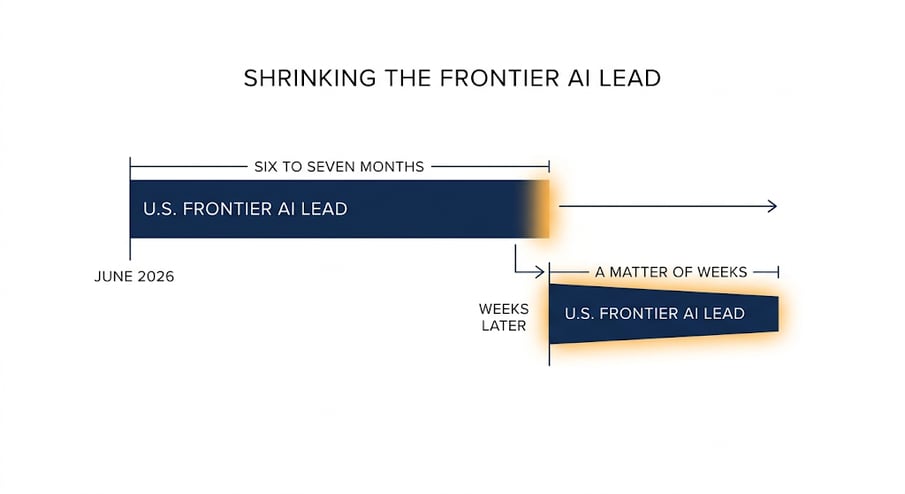
America's AI lead shrank within weeks of being measured. Created via Gemini.
That narrowing lead makes physical execution speed the deciding factor, not model quality alone. Google has pointed to the structural bottleneck underneath the race. The United States operates its power grid through 66 separate balancing authorities, and new interstate transmission lines can take years to permit even when funding and demand already exist.
Meta alone has supported more than 45,000 skilled trade jobs since 2011 building out its 28 U.S. data centers, and the company's $115 million America's Workforce Academy, launched across Louisiana, Ohio, Indiana, and Texas in 2026, reflects how much the AI race now depends on electricians, plumbers, and fiber technicians rather than engineers alone. Whether the country can convert capital and ambition into finished power capacity fast enough to hold any lead at all is now the more decisive competition than the one happening inside AI labs.
Goldman Sachs research estimates artificial intelligence could automate tasks accounting for 25% of U.S. work hours, and that roughly 6 to 7% of workers may be displaced over a 10 year adoption period, raising unemployment by an estimated 0.6 percentage points if the shift unfolds gradually. That same research identifies the counterweight already forming. Data center construction jobs have grown by 216,000 since 2022, and the firm projects roughly 500,000 net new jobs must be filled by 2030 to meet rising U.S. power demand tied to the AI buildout.
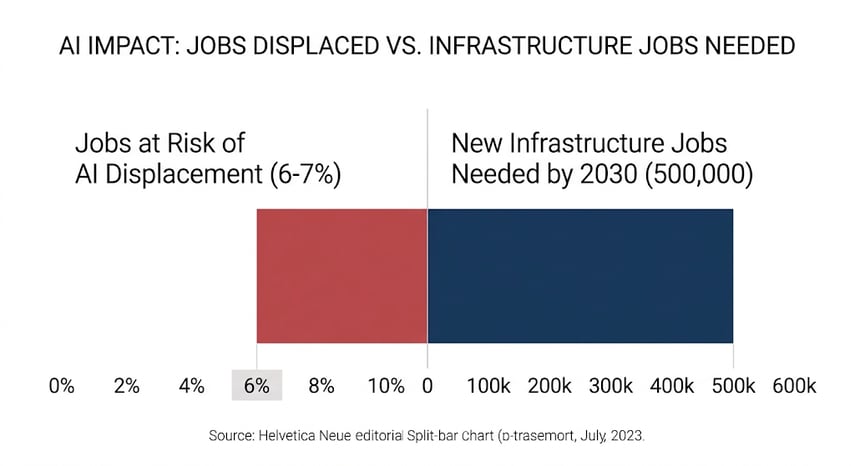
Displacement risk and new infrastructure demand are moving at the same time. Created via Gemini.
That demand is not evenly distributed globally, and the United States holds an outsized share of it. Rystad Energy found the U.S. accounts for more than 40% of expected data center growth among the fifteen leading national markets worldwide, ahead of Canada, Brazil, and Mexico combined. The occupations behind that buildout come with a training bottleneck of their own. The U.S. Bureau of Labor Statistics projects about 81,000 electrician openings and 40,100 heating and cooling technician openings each year through 2034, yet most electrician apprenticeships take 4 to 5 years to complete, meaning the credentialing pipeline cannot simply speed up to match a hiring timeline set by corporate announcements.
That mismatch is the real competitiveness risk hiding inside the AI boom. A country can win the capital race, the land race, and even the chip race, and still lose ground if it cannot train electricians, lineworkers, and HVAC technicians fast enough to build what that capital has already committed to. Community colleges, unions, and employers coordinating around real regional hiring timelines, rather than treating vocational and four-year education as competing tracks, is what closes that gap. Whether that coordination happens at the pace data centers are being announced will determine whether America's AI infrastructure gets built on schedule or stalls waiting on qualified workers.
The Committee for a Responsible Federal Budget confirmed the United States borrowed $1.8 trillion in the first ten months of fiscal year 2026 alone, already more than the government borrowed in all of fiscal year 2025. The Congressional Budget Office projects federal debt held by the public will reach 120% of GDP by 2036, surpassing the previous record set just after World War II. That trajectory matters for more than domestic budgeting. It sits directly beneath the financial advantage that lets the U.S. government borrow more cheaply and quickly than any other country on Earth, an advantage rival economies would need decades to replicate even if the dollar's position weakened significantly.
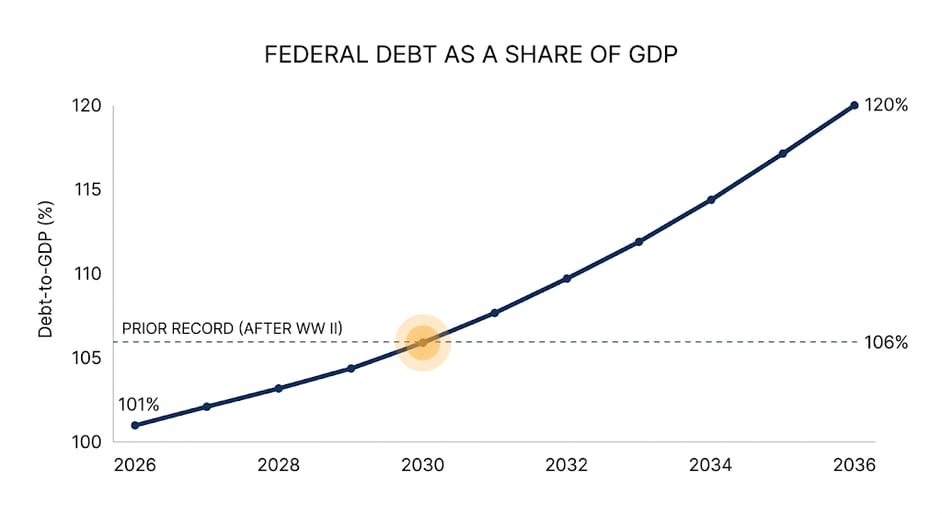
A new debt record is set to surpass the World War II high. Created via Gemini.
That advantage is not disappearing overnight, but it is being tested. The dollar has fallen roughly 10% on a trade-weighted basis since the start of the current presidential term, driven by sharp policy-driven swings rather than a steady decline. Brookings Institution analysis of IMF reserve data found global reserve managers have not meaningfully abandoned dollar holdings despite that volatility, largely because no credible alternative exists at scale. The Chinese yuan has actually lost reserve share over the same period, and the marginal beneficiaries have been smaller currencies like the Swedish krona and Korean won, not a rival reserve currency capable of absorbing serious volume.
That combination, a weakening currency alongside persistent foreign demand for dollar assets, is what makes this a slow-grind risk rather than an acute one. Reserve currency status has historically absorbed enormous fiscal strain without breaking, but each year of trillion-dollar-plus borrowing adds to the premium the country will eventually need to pay to keep foreign capital engaged. A country that cannot fund its own government cheaply loses leverage in every other competitiveness contest on this page, since fiscal room is what pays for the grid buildout, the workforce training, and the industrial policy needed to compete at all.
Customs refunds totaled roughly $71 billion across May and June 2026 after the Supreme Court ruled 6 to 3 on February 20, 2026 that emergency tariffs imposed under the International Emergency Economic Powers Act exceeded presidential authority. June refunds alone reached $49.2 billion, more than double May's total, and outpaced gross customs collections that month, producing a $25.6 billion net customs outflow instead of the revenue gain trade policy is supposed to generate. That reversal contributed directly to a $120 billion federal deficit in June, compared with a $27 billion surplus the year before.
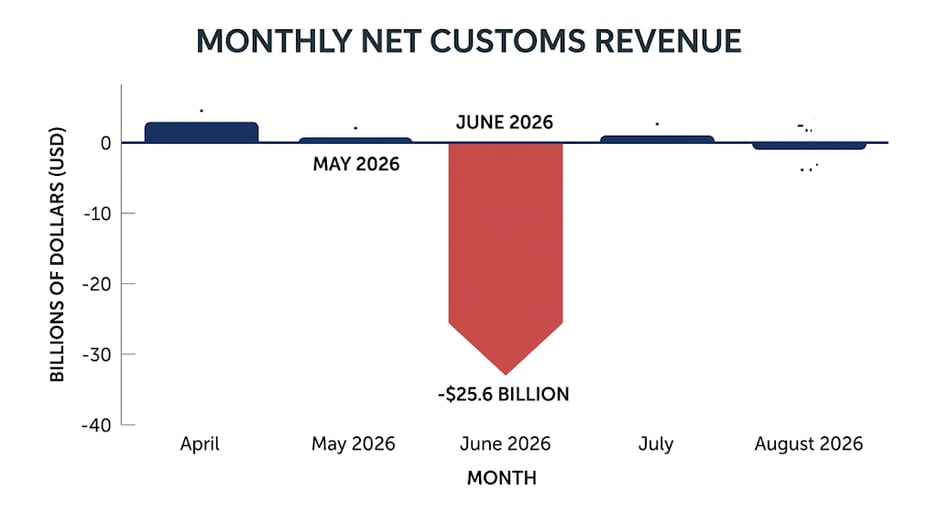
Trade revenue flipped negative once refunds began. Created via Gemini.
The exposure extends well beyond what has already been paid out. Penn Wharton Budget Model estimated more than $175 billion in tariff collections were at risk of refund the day the ruling came down, and independent tracking since then shows well over half of the roughly $166 billion in disputed IEEPA collections still has not been returned to importers. That gap matters for competitiveness strategy specifically, since trade policy built on legally contested authority cannot function as a dependable revenue source or a reliable industrial policy tool.
A government that has to reverse billions in collected revenue months after counting it against the deficit loses both the fiscal capacity and the policy credibility that effective trade strategy requires. That vulnerability points to a structural choice rather than a one-time legal setback. Trade measures built on durable statutory authority, negotiated through Congress rather than emergency powers, do not carry the same risk of being unwound by a single court ruling years after collection began. Whether future administrations rely on that kind of stable authority, or continue reaching for emergency powers that courts can later invalidate, will determine whether trade policy remains a usable lever in America's broader competitiveness strategy or keeps generating fiscal surprises that undercut it.
America's ability to compete now runs through six connected fronts rather than one. China's shrinking energy import dependence is repricing global markets even as record global debt leaves the institutions built to manage economic shocks with less room to respond. A once-wide AI lead can shrink to a matter of weeks between one summit and the next, which makes physical execution speed, not model quality, the deciding factor in whether that lead holds. Behind that execution gap sits a training pipeline that cannot produce electricians and lineworkers as fast as data centers are being announced. Meanwhile, a federal government borrowing at record pace is testing the fiscal foundation that lets America out invest rivals in the first place, and a Supreme Court ruling turned billions in tariff revenue into a repayment obligation overnight, exposing how fragile trade policy built on contested authority can be.
None of these fronts operate in isolation. A country cannot hold an AI lead without the grid capacity to power it, and it cannot build that grid capacity without the fiscal room to invest and the workforce to construct it. A weakening reserve currency premium and a legally fragile trade policy both narrow that fiscal room at the exact moment competitiveness investment needs to expand it. Every one of these fronts represents a lever policymakers are actively deciding how to pull, from permitting reform and workforce funding to trade authority and deficit management, and how those decisions land over the next decade will determine whether America's competitive position strengthens or continues eroding one front at a time.
DOE’s SPARK selections aim to move more electricity through existing infrastructure as data...
-Sep-23-2026-09-13-21-0547-AM.jpg?width=300&name=image%20(1)-Sep-23-2026-09-13-21-0547-AM.jpg)
Landowners who supported Virginia’s Digital Gateway project say local opposition did not only stop...
-Sep-25-2026-10-55-02-0549-AM.jpg?width=300&name=image%20(1)-Sep-25-2026-10-55-02-0549-AM.jpg)
EnerVenue’s move from a planned Kentucky factory to China shows that advanced manufacturing depends...