AI Infrastructure
Unlocking 23 Gigawatts Without Building an Entirely New Power Grid
DOE’s SPARK selections aim to move more electricity through existing infrastructure as data...

Physical and operational infrastructure keeps the country running, and when that capacity gets stretched, thin, or dependent on a single point of failure, the effects reach households, workers, and businesses long before most people notice the strain.
Infrastructure rarely fails all at once. It erodes system by system, usually invisibly, until a shock arrives and the missing capacity becomes obvious to everyone at the same time. A single industrial project can strain a state's power grid before residents ever see it coming. A struggling sector can lose hundreds of operations a year without most consumers noticing until shelves or prices shift somewhere else. A shrinking industrial base limits what the country can produce, move, or repair when it matters most. These pressures show up across energy, agriculture, transportation, manufacturing, and supply chains, and none of them are isolated stories about one industry having a bad year.
What connects these systems is capacity, specifically how much of it the country has left in reserve when something goes wrong. Every new industrial project tests whether the grid, water system, or workforce built for yesterday's demand can absorb tomorrow's. Every supply chain running through a single source or a single foreign processor tests whether a shock, shortage, or geopolitical dispute can freeze an entire sector. This page tracks those systems as they are stressed, expanded, or put at risk, and follows the policy decisions shaping whether America keeps enough resilience in reserve for the next disruption.
Meta and Blue Owl Capital committed a combined $27 billion to build the Hyperion campus in Richland Parish, a rural Louisiana county with unemployment well above the national average. Officials project the completed site could draw as much as 7.5 gigawatts from the grid, with 5 gigawatts dedicated purely to compute power. Louisiana's statewide peak demand historically reaches 13 to 15 gigawatts during summer months, which means a single campus could add the equivalent of roughly a third to half of the entire state's baseline load. That scale is exactly why site selection has become as much an infrastructure decision as a corporate one, testing whether a regional grid, water system, and workforce can absorb an industrial consumer of this size without straining everything built around it.
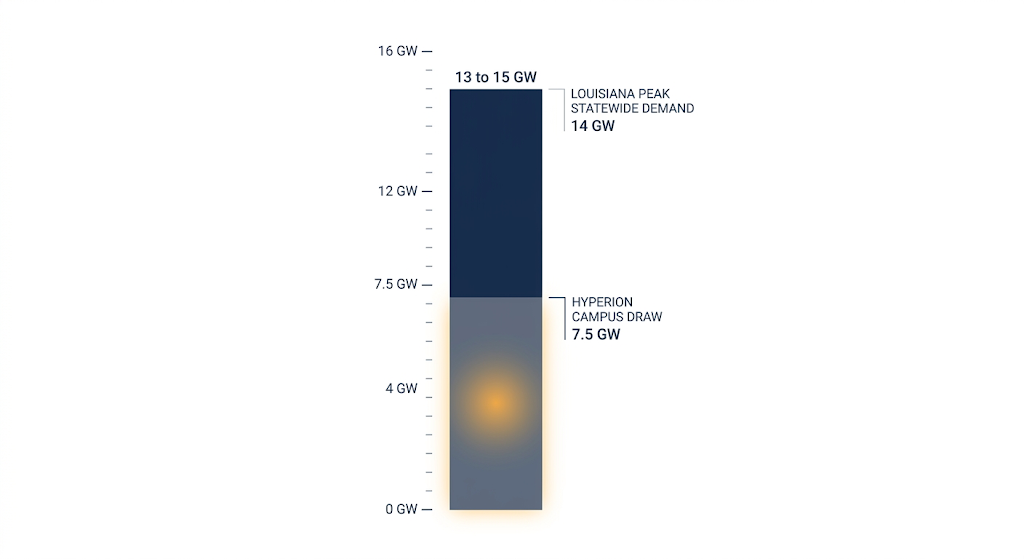
One campus could add half the state's baseline demand. Created via Gemini.
Louisiana structured Act 730 to grant Meta up to $3.3 billion in sales tax exemptions, tied to minimum thresholds of 50 permanent local jobs and $200 million in capital investment, turning the incentive into a performance contract rather than a blank check. Entergy Louisiana has committed renewable energy specifically to meet the new load, which means the utility is now building generation and transmission capacity years ahead of where it would have otherwise, a bet that only pays off if the demand materializes as promised. A December 2025 Louisiana Public Service Commission rule allows data center developers to cover only 50% of new power infrastructure costs, shifting real financial exposure onto the same grid the state is racing to expand.
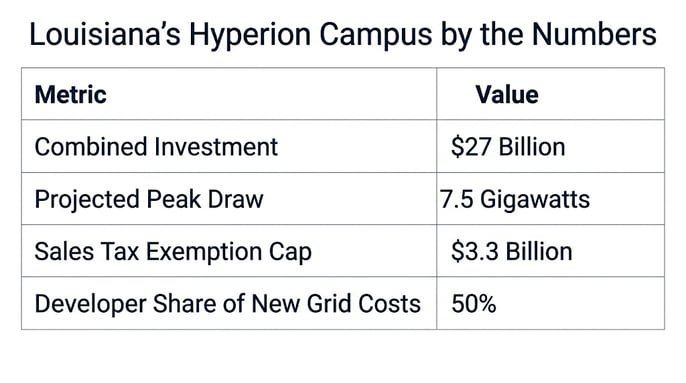
Louisiana's incentive deal still shifts real cost onto the grid.Created via Gemini
Earthjustice has warned that Meta's financing structure through Blue Owl allows the company to exit its lease as early as 2033, a full decade before some of the infrastructure built for this project would otherwise be paid off. That risk illustrates the core siting question for infrastructure of this scale, whether new industrial capacity strengthens a region's systems for the long term, or borrows against them on a timeline that outlasts the company that requested them. Richland Parish is a preview of a decision playing out in dozens of other rural counties as the AI buildout accelerates, and how it resolves will shape how the next wave of massive infrastructure projects gets sited, financed, and absorbed.
Farm bankruptcies climbed to 315 filings in 2025, a 46% jump from the prior year and the second consecutive annual increase, according to Farm Policy News. Every closure removes a working piece of the system that grows the country's food, and the pattern is not a single bad season correcting itself. Median farm-only income fell to negative $328 in 2025, meaning the average farming household now loses money on agricultural production itself before counting anything earned outside the farm.
Beth Ford, President and CEO, Land O'Lakes
That gap survives only because nearly 90% of farm families depend on wages from a separate job to cover basic household expenses, a dependency that keeps total household income positive even as the farm itself operates at a loss. Beth Ford, president and CEO of Land O'Lakes, has called this convergence of pressures a gathering storm, and the demographic trend underneath it makes the strain harder to reverse. More farmers today are over age 75 than under age 35, which points toward a shrinking production base just as the industry needs new operators willing to enter a business with negative baseline margins.
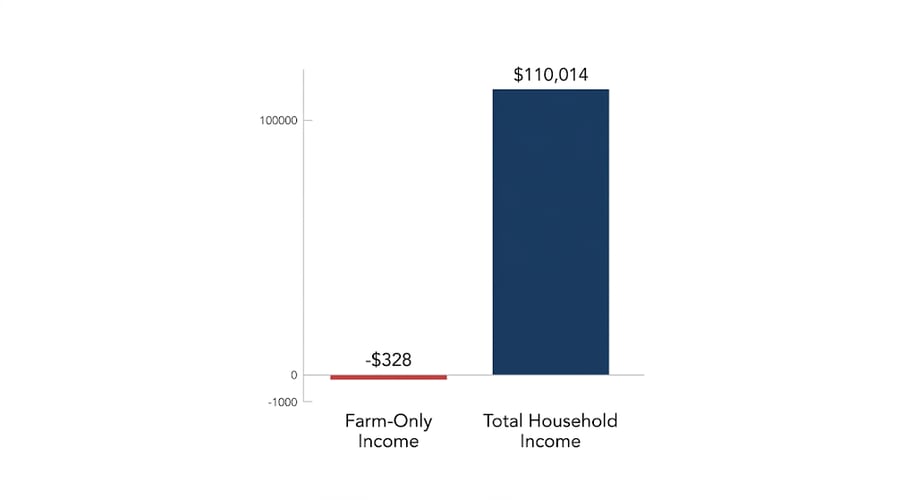
Off-farm wages, not farming, keep households financially afloat. Created via Gemini.
Labor shortages compound the income problem rather than sitting apart from it. A Washington Post investigation found that the federal Labor Department has itself acknowledged tougher immigration enforcement is straining harvest capacity, leaving crops unpicked in fields when workers cannot be found. Layered on top of that is a policy gap: Congress has not passed a full Farm Bill since 2018, forcing farmers to make multi-year land, seed, and equipment decisions under short-term extensions rather than the long-term certainty the industry runs on. A food system operating on negative margins, an aging workforce, a labor shortage, and an expired policy framework is a system with very little capacity left to absorb the next shock, whether that shock is weather, trade, or another labor disruption.
China builds more than 1,000 large oceangoing commercial vessels a year, while the United States builds fewer than 10, a gap specific to commercial shipbuilding capacity rather than the country's entire industrial base. At the Energy Imperatives Summit, Sen. Todd Young described the loss behind that number as more than a shortage of hulls. A shipyard depends on steel plate, engines, cranes, electricians, welders, dry docks, and training pipelines working together, and once that ecosystem disappears, rebuilding it takes years of predictable demand rather than a single contract or tax credit.

Sen. Todd Young U.S. Senator, Indiana
The bipartisan SHIPS for America Act is designed to rebuild that capacity through investment incentives, shipyard expansion, and mariner recruitment, following a similar logic to past industrial policy that treated a sector as too strategically important to lose entirely. Behind the shipyard gap sits a steel supply problem that limits how fast any rebuild can happen. North American Iron estimates the United States produces roughly 100 million tons of steel a year against China's roughly 1 billion tons. The country remains largely self-sufficient in raw iron ore, but domestic steelmakers rely on Brazil for about 75% of imported merchant pig iron, a high-purity feedstock used in electric arc furnaces.
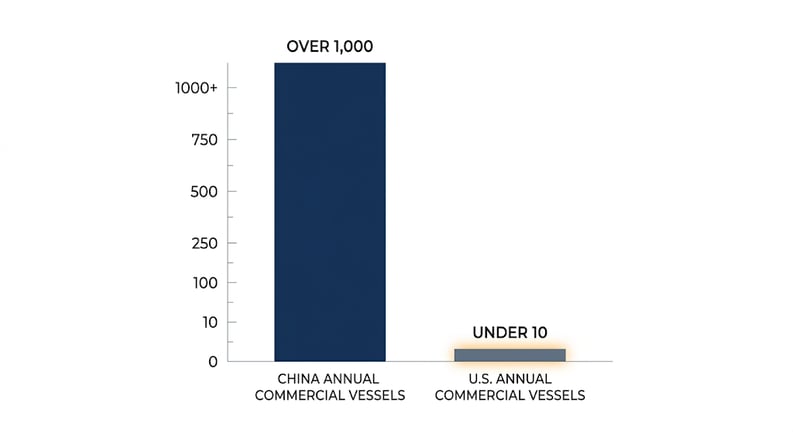
Commercial shipbuilding output diverges sharply between the two countries. Created via Gemini.
That reliance on a single foreign source for pig iron means a shipbuilding revival cannot be fully separated from steel supply strategy, since a shortage in that feedstock limits what shipyards can actually produce even with new funding in place. Steel also reaches far beyond ships, running through vehicles, bridges, data centers, and defense systems, which means a disruption to Brazilian pig iron imports would ripple across nearly every other system this pillar tracks. Rebuilding shipbuilding capacity is ultimately a test of whether the country can restore an entire industrial layer at once, not just add ships to a production line.
China accounts for roughly 70% of global rare earth mining, but the sharper chokepoint sits further down the supply chain. CSIS analysis finds China controls close to 90% of the world's heavy rare earth processing and rare earth magnet manufacturing, the stage that turns raw material into usable components. That concentration means a phone, electric vehicle, or piece of defense hardware can look domestically sourced at the mining stage and still depend entirely on Chinese-controlled refining before it becomes a finished part.
Traditional mining cannot close that gap quickly, since permitting, financing, and building a new mine can take years before producing usable material. The Department of Energy has committed $134 million toward secondary recovery projects designed to pull rare earth elements from red mud, mining tailings, and electronic waste already sitting above ground rather than waiting years for new extraction. A project near Gramercy, Louisiana, is examining a red mud deposit containing more than 30 million tons of bauxite refining byproduct, with potential to supply between 150 and 1,000 metric tons of rare earth elements annually.
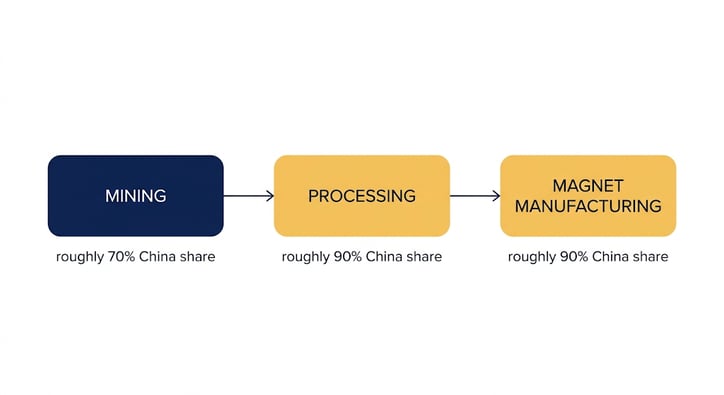
Control concentrates sharply at processing and magnet stages. Created via Gemini.
Closing that gap for good requires moving lab research into real manufacturing capacity, which is where national lab infrastructure comes in. A $250 million federal user facility is designed to help move rare earth and critical mineral technologies from early experiments through pilot lines and into competitive commercial production, addressing the stage where many promising projects historically stall. Federal officials have also described economic security zones with trusted partner countries as a way to move processing and manufacturing steps outside China's control entirely, reducing the risk that a single geopolitical dispute could freeze materials needed across consumer electronics, vehicles, and defense systems.
Congress backed a $12 billion public-private critical minerals stockpile known as Project Vault, supported by a $10 billion Export-Import Bank loan, according to the Bipartisan Policy Center. The reserve lets participating manufacturers help select which minerals get purchased and from which suppliers, creating an emergency buffer against supply disruptions before they reach factory floors. That structure addresses one real problem, since the U.S. Geological Survey reports the country imported 80% of the rare earth elements it used in 2024.
A stockpile only cushions a shock, though, and does not by itself create anything the country currently lacks. The reserve carries no firm sourcing mandates, no guarantee that stockpiled materials get processed domestically, and no built-in mechanism to expand American mining or refining capacity. Congress is separately weighing measures covering domestic processing incentives, mining education, permitting reform, and mineral mapping, each aimed at the production side of the problem that a stockpile alone cannot touch.
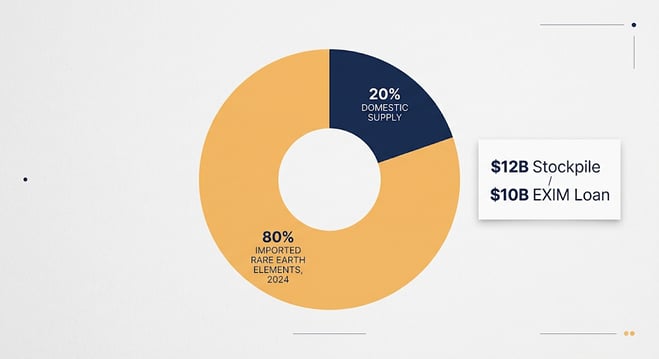
Imports dominate supply despite a new twelve billion dollar reserve.Created via Gemini.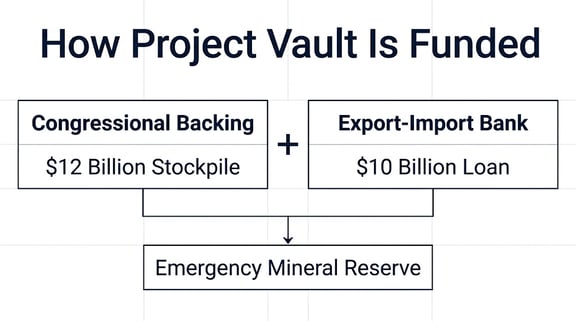
Two separate federal funding sources back the new minerals reserve.Created via Gemini
That distinction matters most for how the reserve gets used over time. Analysts have warned that price stabilization through the stockpile requires real commodity expertise, strong oversight, and clear operating rules, since a poorly managed reserve could distort markets rather than steady them. Congress could still attach sourcing requirements, domestic processing incentives, and a sunset date to keep the program a temporary bridge rather than a permanent substitute for building actual mining and refining capacity at home. Whether Project Vault becomes a genuine bridge toward domestic capability or simply a warehouse for imported material will depend on decisions still being made in Washington.
None of these systems fail in a way that stays contained to the industry where the strain starts. A grid stretched by a single data center campus can raise electricity bills for an entire region years before the facility opens. A food system running on negative farm income eventually shows up as fewer producers and less price stability at the grocery store. A shipbuilding gap limits the industrial jobs that once offered skilled, well-paying work without a four-year degree. A mineral supply chain running through a single foreign processor can delay or raise the price of the phone, vehicle, or appliance a family needs to replace. Reserves like Project Vault can soften the landing when one of these systems is disrupted, but they cannot replace the jobs, capacity, or resilience that only comes from rebuilding the systems themselves.
Each of these systems has an active policy fight attached to it right now. State utility regulators are deciding how much of new grid infrastructure gets paid for by developers versus ratepayers. Congress has left a full Farm Bill unresolved since 2018, forcing agricultural policy to run on short-term extensions. The SHIPS for America Act is still working through Congress as the primary vehicle for rebuilding commercial shipbuilding capacity. Lawmakers are weighing separate bills covering mineral processing incentives, permitting reform, and mining education, and Congress retains the ability to attach sourcing rules and a sunset date to Project Vault before it becomes a permanent fixture rather than a temporary bridge. How these decisions land will determine whether the country closes these capacity gaps or manages them indefinitely. Infrastructure decisions made today, in state utility commissions, in Congress, and in boardrooms, will determine how much resilience the country has when the next disruption arrives.
DOE’s SPARK selections aim to move more electricity through existing infrastructure as data...
-Sep-23-2026-09-13-21-0547-AM.jpg?width=300&name=image%20(1)-Sep-23-2026-09-13-21-0547-AM.jpg)
Landowners who supported Virginia’s Digital Gateway project say local opposition did not only stop...
-Sep-25-2026-10-55-02-0549-AM.jpg?width=300&name=image%20(1)-Sep-25-2026-10-55-02-0549-AM.jpg)
EnerVenue’s move from a planned Kentucky factory to China shows that advanced manufacturing depends...