Financial Literacy
The Price on the Sign: Why Gasoline Remains an Immediate Affordability Test
Record Labor Day fuel prices show why a cost seen every day can quickly shape the national...

American households now face record debt, high borrowing costs, and shifting credit rules, making it harder to understand how interest, fees, medical bills, and repayment choices affect everyday financial stability for millions nationwide.
Consider a household carrying a credit card balance while also dealing with an unexpected medical bill and a student loan payment. The card balance becomes more expensive each month because interest keeps accruing, a missed due date can trigger another fee, and the medical bill may eventually affect the household's credit profile depending on reporting rules. At the same time, money directed toward debt service is money that cannot go toward emergency savings, a home down payment, retirement contributions, or other priorities. None of these pressures operates in isolation, which is why understanding APRs, delinquency, credit reporting, and repayment terms matters as much as knowing the amount owed. This page explains those connections and what they mean for financial decisions.
Household debt is not one single bill. It is the combined weight of mortgages, credit cards, auto loans, student loans, and other obligations competing for the same monthly income. A family can remain current on every account and still feel financially squeezed when required payments consume more of each paycheck and leave less room for savings or unexpected expenses.
The scale of that pressure has continued to grow. Total U.S. household debt reached $18.8 trillion in Q1 2026, after households added $591 billion over the previous year. The national total does not determine whether an individual family is in financial trouble, but it shows how extensively borrowing obligations have become embedded in household balance sheets.
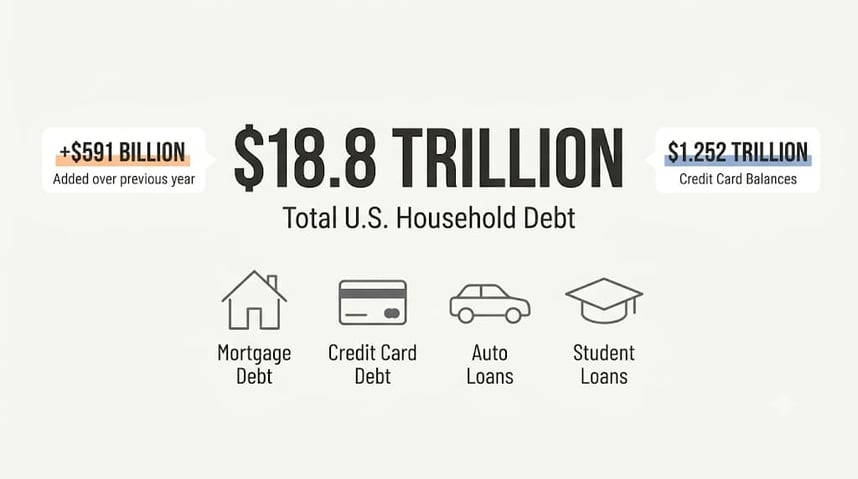
Household debt keeps climbing across major obligations. Created via Gemini.
Credit cards show why the amount borrowed is only part of the financial burden. Card balances reached $1.252 trillion in Q1 2026, while the average APR on cards accruing interest stood at 21.52% and 13.1% of balances were seriously delinquent. For households carrying balances, high interest means a larger share of each payment can go toward financing the debt rather than reducing what was originally owed, making it harder to regain room in the monthly budget.
That is why financial stress is better understood through monthly cash flow than through debt totals alone. The pressure grows when interest is joined by penalties that can arrive precisely when a borrower is already struggling to make a payment. Credit card late fees bring that issue into sharper focus, because efforts to reduce those penalties raise the next question: whether eliminating one cost actually makes credit cheaper or shifts the cost somewhere else.
A credit card late fee is more than a penalty for missing a due date. It arrives when a borrower may already be carrying interest, making minimum payments, or struggling with other bills. That timing is why late fees have become a policy target, but reducing the fee does not automatically remove the underlying cost of late payments from the credit system.
The current debate centers on a proposal to cap late fees at $8 for large card issuers, compared with standard fees of about $30 for a first late payment and $41 for repeat late payments. American consumers pay roughly $14 billion each year in credit card late fees, while the large issuers targeted by the proposal account for about 95% of outstanding card debt. For borrowers who occasionally miss a payment, the immediate benefit is straightforward: a smaller penalty leaves less additional debt sitting on an already expensive balance.
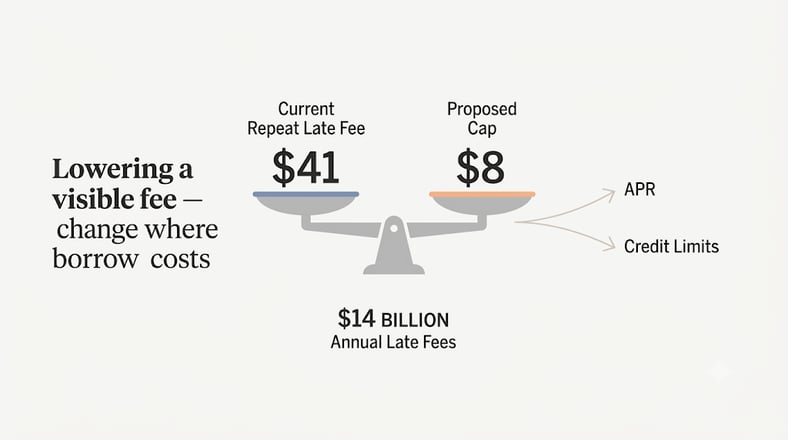
Fee caps can shift borrowing costs elsewhere. Created via Gemini.
For a borrower who would otherwise pay a $41 repeat late fee, an $8 cap could reduce that immediate charge by $33. The harder question is what happens to the revenue lenders no longer collect through penalties, especially because 74% of cardholders pay on time and do not currently incur late fees. Banks and credit-industry groups argue that some of the lost revenue could reappear through higher APRs, lower credit limits, or tighter underwriting, spreading part of the cost across borrowers who never trigger the original fee.
That tradeoff is what makes consumer-finance rules difficult to judge by the headline number alone. A policy can lower one charge for households under stress while creating different costs elsewhere, so the practical question is who saves, who pays more, and how access to credit changes afterward. That becomes even more important with medical debt, where the borrower often did not choose to take on the obligation in the first place.
Medical debt enters a household balance sheet differently from most other forms of borrowing. A consumer usually chooses to open a credit card, finance a car, or take out a mortgage, but medical bills can follow an emergency, insurance dispute, billing error, or treatment whose final cost was unclear beforehand. That difference matters because a debt created during a health crisis can still affect the same credit system used to judge future borrowing.
The scale of the problem reaches well beyond people without insurance. In 2023, 1 in 8 adults ages 50 to 64 had unpaid medical bills, and 70% of those with medical debt were insured when they incurred it. Those figures show that coverage does not always prevent a medical event from becoming a financial obligation that competes with rent, loan payments, savings, and other household expenses.
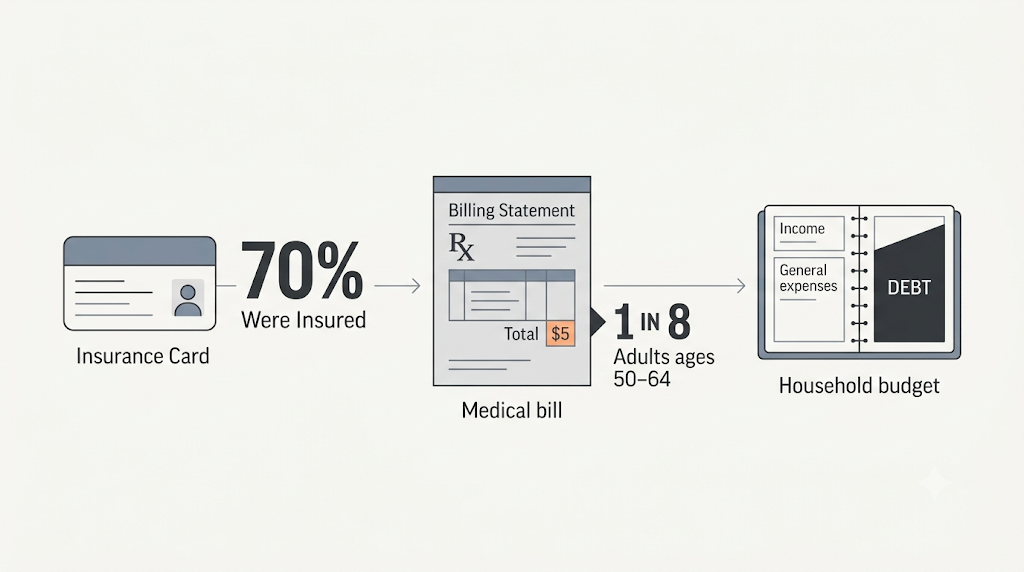
Insurance does not always prevent medical debt. Created via Gemini.
Once a medical bill moves into collections, the question becomes whether it should influence a consumer's credit profile in the same way as other unpaid obligations. The three major credit bureaus voluntarily stopped reporting medical collections under $500 in 2023, while 15 states have enacted broader protections restricting medical debt on consumer credit reports. Supporters argue that health-related bills can be a poor measure of ordinary repayment behavior, while lenders argue that removing legitimate unpaid obligations gives them less information when evaluating financial risk.
The dispute shows why understanding debt requires more than knowing how much someone owes. Consumers also need to understand how an obligation can affect cash flow, credit access, and the choices available years later. That longer-term effect becomes clearer with student debt, where repayment can continue while households are trying to buy homes, raise families, and save for retirement.
Debt becomes more than a monthly payment when repayment stretches across decades. Long-term balances can compete with the money households would otherwise use for a home purchase, raising children, emergency savings, or retirement. Student debt shows this clearly because many borrowers are carrying repayment obligations well beyond the early-career years when those loans were originally taken out.
More than 3.5 million borrowers defaulted on student loans between October 2025 and March 2026, while the average borrower entering serious delinquency was nearly 40 years old. Total student-loan debt had grown to about $1.838 trillion, showing that repayment pressure now reaches well into the working lives of millions of Americans. For households already balancing housing, transportation, credit cards, and family expenses, a student-loan payment can reduce the financial room available for other long-term goals.
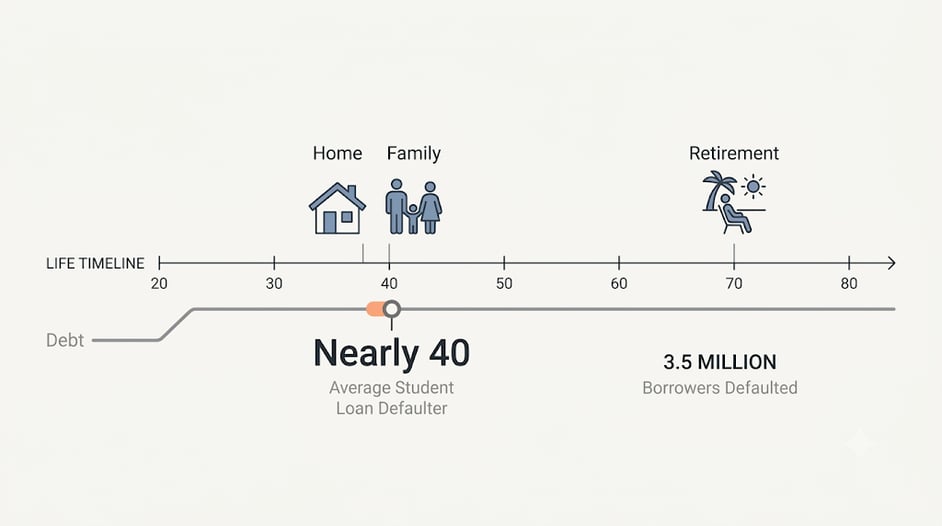
Debt increasingly follows borrowers into midlife. Created via Gemini.
The effects can appear in decisions that build household wealth and shape family life. The source article reports that each $1,000 increase in student debt is associated with a 1.8% decline in homeownership likelihood among recent graduates under 35, while borrowers with high debt burdens had 22% lower odds of having children than debt-free peers. These relationships do not mean debt alone determines whether someone buys a home or starts a family, but they show how repayment obligations can change the financial calculations behind those decisions.
The consequences can continue even after the traditional milestones of early adulthood have passed. Workers over 50 carrying student debt had retirement balances averaging 30% lower than those without it, leaving less time to rebuild savings before leaving the workforce. That is the larger lesson of everyday debt mechanics: interest, minimum payments, and long repayment periods can shape not only what a household can afford this month, but what it can realistically plan for years from now.
America's $18.8 trillion household debt problem is not simply a story about families owing more money. Credit card balances become harder to reduce when APRs exceed 21%, late payments can add penalties, and medical bills can enter a household budget without the borrower ever choosing to take on debt. What matters is how each obligation changes the amount of income a household still controls after the bills are paid.
The policy choices are just as specific. Cutting a repeat credit card late fee from $41 to $8 may help borrowers who miss payments, but lenders could respond by changing rates, limits, or underwriting elsewhere. Medical debt creates a different problem because 70% of midlife adults with medical debt were insured when they incurred it, raising questions about whether a health-related bill should affect access to future credit in the same way as ordinary borrowing.
The consequences can last far beyond the month when a bill first comes due. Student-loan borrowers entering serious delinquency are now nearly 40 years old on average, showing how debt can remain attached to households while they are trying to buy homes, raise families, and prepare for retirement. The clearest lesson from this page is that understanding debt means following the full chain from the original balance to the interest, penalties, credit consequences, and opportunities that repayment can eventually crowd out.
-3.jpg?width=300&name=image%20(3)-3.jpg)
Record Labor Day fuel prices show why a cost seen every day can quickly shape the national...
-Sep-01-2026-09-44-44-6942-AM.jpg?width=300&name=image%20(1)-Sep-01-2026-09-44-44-6942-AM.jpg)
Americans still believe in enterprise. What they increasingly distrust is an economy that appears...

A universal investment seed can expand ownership, yet unequal contributions may compound the wealth...